Teacher Resources

Resisting the Race

my search for slowness

We live in an era of speed, with more information available at our fingertips than ever before. The pressure to do more and become more at an astronomical pace is pervasive—something I’ve had to consciously resist in both my teaching practice and in life.

In an effort to resist the race from concept to concept, level to level, I have an ongoing goal to add more slow, exploratory, student-centered approaches to my teaching repertoire. Students remember new topics when they are actively involved, and my teacher burnout level stays the lowest when I spend my time creating learning experiences rather than simply telling students what I want them to know.

Three topics consistently pinged on my “this is not working” radar — a sure sign that my lesson planning needed more thoughtful preparation. Using the metronome, making clefs and landmark notes more memorable, and fielding questions about how a piano works are three topics that I have re-worked my approach to, favoring a slower and more careful way of introducing them to students—and it’s working!

Preparing for the Metronome

Different uses for the metronome is an entire blog topic of its own, but my short philosophy about metronomes revolves around a single idea: the metronome validates a student’s sense of steady beat, but it does not develop it. With that in mind, I ensure that students are able to do a variety of movement and chanting activities that require them to keep the macrobeat and microbeat both alone and simultaneously before they ever see a metronome. I also have students tap the macrobeat while I tap its different divisions. Then, it’s time to think carefully about the student’s first experience with the metronome.

First, we take our time exploring what a metronome can do. It’s so often the outwardly simple things that involve more than meets the eye. Of course, the metronome keeps a beat. But where do the numbers come from? Which beat or note value does the click represent, and why? Do we only use the metronome to keep a beat? How do we actually listen to the metronome while playing? I never introduce the metronome without anticipating the questions students will ask and what they will naturally want to experiment with. Some discussion points and activities that are worth the time include:

  • 60 BPM chimes exactly with the second hand on a clock; we set the metronome to that speed and watch the analog clock on the wall in my studio. We experiment with doubling that number (120 BPM), then cutting it in half (60 BPM) and talk about what we observe. I want this to hint at the idea that the metronome can be set to the half note, eighth note, or other divisions and elongations of the beat. The sound can represent more than one thing!

  • We tap common rhythmic patterns with the metronome set to adagio, andante, and allegro.

  • We play a familiar piece with the metronome set to the quarter note at a comfortable tempo, then experiment with playing the same piece much slower and a bit faster than usual, still with the quarter note as the beat. As a stepping stone to playing with the metronome set to the whole note, half note, eighth note, and so on, I simply tap those values on their shoulder while they play.

  • We tap rhythms from already-completed sight-reading cards with the metronome set to a comfortable tempo while counting aloud, then try this process with new sight-reading material.

We repeat variations of these activities for several weeks, taking the time to build students’ self-efficacy before students are assigned metronome work in at-home practice. The more confident students are in their ability, the more likely they are to practice it at home!

Exploring How a Clef Actually Works

I didn’t fully understand the underlying purpose of a clef until my first year of music school. Suddenly, I had to read, sight-sing, and complete music theory assignments in new clefs (alto and tenor clefs) that I didn’t even know existed! This changed the way I thought about reading music and became a lasting influence on my pedagogy, especially when it comes to sequencing music-reading concepts and skills.

A clef assigns pitch and letter name meaning to the lines and spaces on the staff, assigning a particular pitch to one line or space and, by association, all the other lines and spaces (including ledger lines). To ingrain this in a creative way, students have been designing their own clefs—and it’s a deep-dive activity that I have found to be more than worth the time.

A clef in which middle C aligns with the handle on a saber.
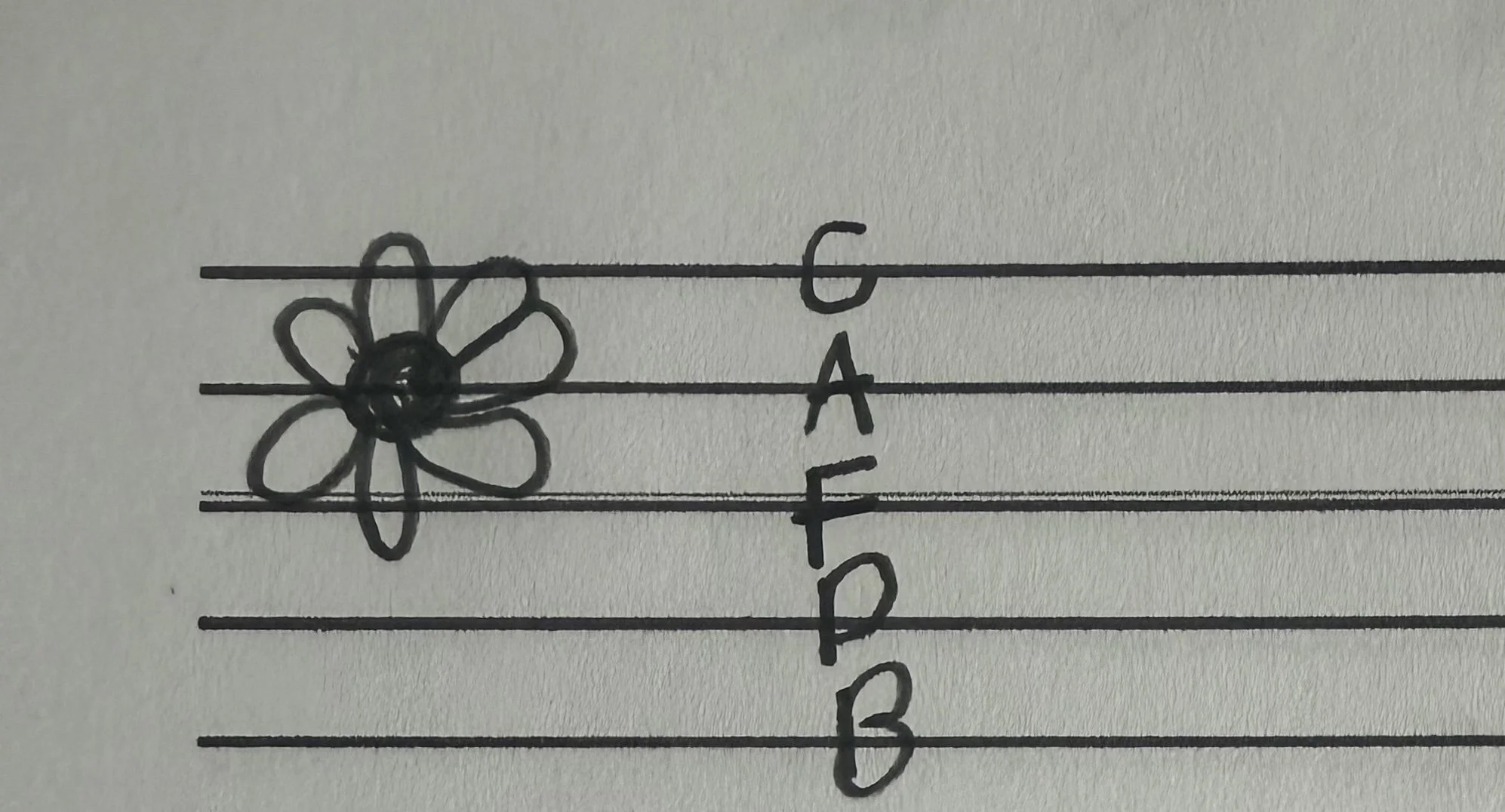
A clef in which the high A (A5) line goes through the pistil of a flower.

This activity has resulted in so many “aha!” moments—even in students who have been reading on the staff for quite some time—that I plan to continue using it every time I introduce clefs. Student-designed clefs would also add a wonderful layer of complexity to our next sight-reading card swap, where students notate sight-reading exercises for each other.

Exploring What’s Inside the Piano
Students are naturally curious about how things work, including what’s inside of the piano and the pedals—and they ask a lot of questions about what each part does. It’s easy to feel rushed when students have a lot of questions and limited lesson time. There is a lingering feeling of urgency to get straight to the music and spend as much time playing the instrument as possible, a remnant from my own experiences as a student and teacher in training. Rather than working against this curiosity, spending the time to lay a foundational understanding of how a piano works is worth it.

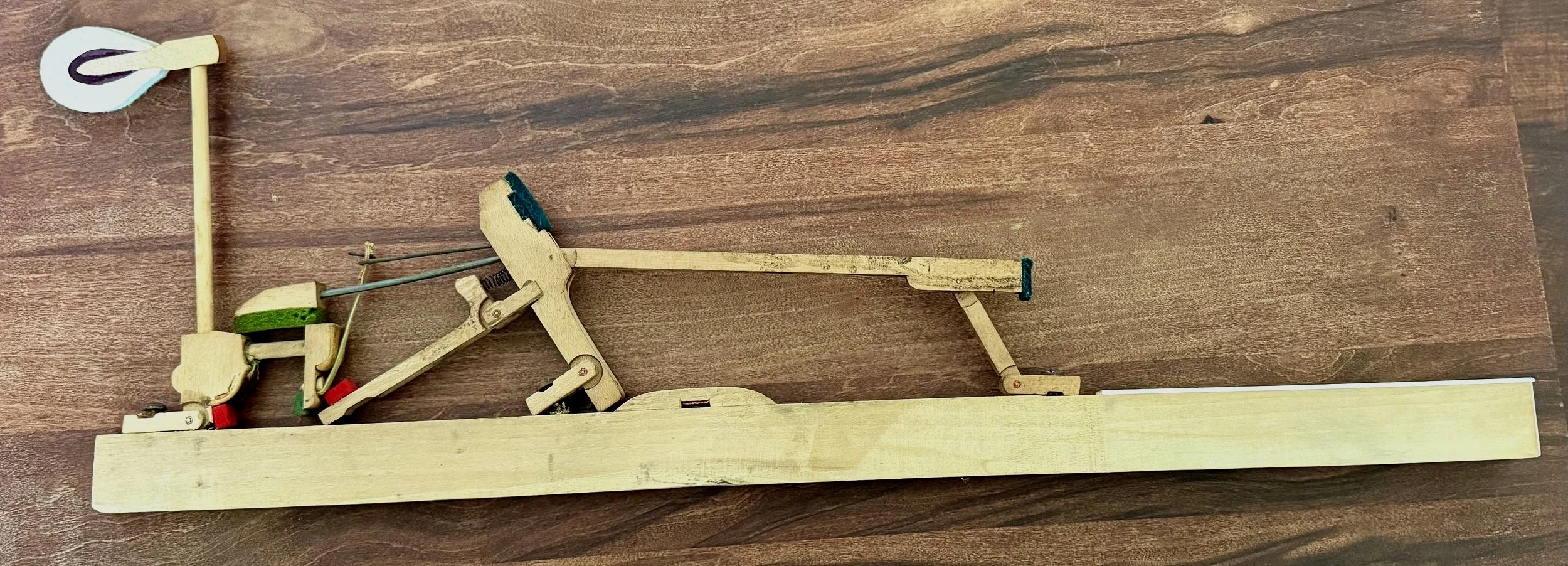
Allowing students to explore how an acoustic piano makes a sound very early in the lesson experience has become a cornerstone of my teaching philosophy. We take a peek at what’s inside the instrument; I open the lid and ask students to make as many observations as they can about the strings, hammers, dampers, pins, and anything else they notice. Students have been fascinated by the model piano action I invested in last year. Seeing the action from multiple angles and being able to feel all the parts helps students understand how their physical actions work together with the piano’s parts.

I’ve honed the language I use to discuss interacting with the piano mechanism: we don’t “press” the keys, we “strike” them to engage the machine inside; we don’t “hold” down a key, we “leave” our finger on the key, because once a sound is made, we can’t alter it, etc. These concepts are more easily understood, even by the tiniest of learners, when they can see and feel what I’m talking about.
Taking Time to Save Time?

The longer I teach, the more strongly I believe that slowness is one of the most powerful choices we can make, in the music world and otherwise. Taking time to explore, question, and interact with foundational concepts is an investment in lasting progress—one that ultimately allows us to use time more efficiently in the future.


Further Reading
A Long, Slow Look (on the blog)
In Praise of Slowness by Carl Honore
Perfect Practice Part 3: Interleaved Practice

What is interleaved practice?

Interleaving is the process of structuring practice so that students move frequently from one topic to another. As opposed to blocked practice, which repeats the same skill with little interruption, interleaved practice rotates concepts frequently, even if they’re not yet mastered.

At first glance, this approach can seem counterintuitive. Wouldn’t it make more sense to finish one thing before moving on? Research suggests otherwise. Interleaved practice increases long-term learning and retention—a phenomenon known as the contextual interference effect. Contextual interference has been studied in a variety of fields—most notably in sports—and, more recently, in music. In addition to enhanced learning, interleaved practice has been shown to boost executive functions like goal-setting, planning, and focus. (Carter and Grahn 2016).

How do we implement interleaved practice?

Understanding the benefits of interleaving is one thing; implementing it is another. Some students feel uneasy switching tasks quickly. There can be a sense of incompleteness when a passage isn’t fully polished before moving on. Many musicians were trained primarily through blocked repetition, so deviating from that model can feel unfamiliar—even uncomfortable.

As with any practice strategy, the most natural way to introduce interleaving is to model it in the lesson. When students experience frequent, intentional shifts between tasks, the structure becomes familiar rather than jarring. My personal challenge with interleaving the lesson structure is trusting that learning is happening despite a student’s in-the-moment performance occasionally decreasing. According to the literature on context interference, this is to be expected!

A Basic Interleaved Structure

Interleaving works best when practice has clearly defined topics. Each topic calls for different practice strategies, and rotating among them keeps the brain engaged and prevents practice from becoming automatic.

Common practice tasks to interleave might include:

  • Technical work (in exercises or within repertoire)

  • Memory work

  • Improvisation

  • Performance preparation

  • Note and rhythm accuracy

  • Sight-reading

  • Voicing

  • Increasing tempo

  • Expressive refinement

An hour-long interleaved practice could look like this.

Student-Led practice plans

Students don’t need a formal explanation of the term “interleaving.” When the structure is modeled consistently in lessons, they quickly internalize the rhythm of shifting focus. I’ve incorporated interleaved practice even with my youngest students, and they adapt to it quickly when it’s presented as a normal part of our routine.

This student noticed that the pattern of repeated notes ends in the last two measures, so he put a practice square around them.

Marking specific practice points has been especially helpful when structuring interleaved work at home. Students identify and mark challenging passages—often with a square or removable highlighting tape—and explain why that section needs extra attention. However, the word “difficult” is something that we avoid in this context. Rather, we call difficult passages “the fun part,” “the impressive part,” or, as one of my students puts it, “the spicy part.” This reframes challenges in a fun way that fosters a positive attitude toward practice.

Students can cycle through the practice squares from all their pieces, creating context interference. The key is to practice each section only until it begins to feel easier—not until it is note-for-note perfect. This allows the brain to stay engaged and prevents autopilot repetition. From there, students can work on integrating the practice squares into the larger context of the piece.

With blocking, once you know what solution to use, or movement to execute, the hard part is over. With interleaving, each practice attempt is different from the last, so rote responses don’t work. Instead, your brain must continuously focus on searching for different solutions. That process can improve your ability to learn critical features of skills and concepts, which then better enables you to select and execute the correct response.
— Steven C. Pan

Real-life Results

Since actively encouraging interleaved practice, I’ve made some general observations:

  • less frustrated by making mistakes and more self-compassionate

  • more reflective on their work, verbalizing what they missed and why they think they missed it before moving onto the next repetition of a passage

  • more thoughtful before playing rather than diving headfirst into a piece

Although a great number of factors can shape these positive behaviors, I believe that the de-emphasis on perfection inherent to interleaved practice might play a role.

Further Reading

A Short Read: The Interleaving Effect: Mixing It Up Boosts Learning

A Deeper Dive: Optimizing Music Learning: Exploring How Blocked and Interleaved Practice Schedules Affect Advanced Performance

Carter CE and Grahn JA (2016) Optimizing Music Learning: Exploring How Blocked and Interleaved Practice Schedules Affect Advanced Performance. Front. Psychol. 7:1251. doi: 10.3389/fpsyg.2016.01251

A Long, Slow Look

Using the practice of slow looking to tell musical stories

What is slow looking?

The phrase “slow looking” simply means taking intentional time to look closely at something. In her book Slow Looking: The Art and Practice of Learning Through Observation, Shari Tishman elaborates: “The term slow looking uses the vernacular of the visual, but it is important to emphasize that learning through prolonged observation can occur through all the senses” (Tishman 2). Unlike mindfulness, a state of being that also draws our focus to the present moment, we slow look with the intent to gain knowledge.

Tishman’s book, bolstered by findings from her educational research, walks us through slow looking strategies and the positive impact slow looking makes in educational settings. It aligns naturally with discovery learning, in which students construct knowledge through exploration rather than passive explanation. When students uncover patterns and meaning for themselves, their learning is both deeper and more memorable.

Slow Looking in Action

Visual art provides a natural context for slow looking. When observing a work of art, we might ask:

  • What do I see? What do I think about what I see? How do I feel about what I see?

  • What did I notice first? What did I notice after looking for a while?

  • What words come to mind as I look?

  • What more would I like to know about the artwork?

  • Do small parts create the big picture?

  • Does this remind me of something else?

  • How do I think this artwork was created? Were elements added in a certain order?

Ruth Asawa, Desert Plant, 1965

Using Slow Looking as a Springboard for musical Improvisation

In music, slow looking helps students notice patterns, structure, character, and contrast; students train their brains to notice the layers and details that comprise a tapestry of sound. Slow looking lends itself well to two activities that have been met with enthusiasm in my studio: telling a story through music and improvising or composing new music using ideas from an existing piece. I’ve found that combining these two activities is an effective way to encourage students not only to listen slowly but also to improvise with less inhibition. By placing parameters—like improvising using rhythmic or tonal patterns we discovered through slow looking—students can create with clarity and confidence.

Part One: Introduction to a new piece

To encourage students to think about character and mood, I perform a piece with the title hidden and have them guess what it could be about. Students use the practice of slow looking to find patterns and identify how the elements of music (e.g. melody, harmony, form, texture, dynamics) are at play in a given piece.

Next, we compare the title they brainstormed with the original title. It’s amazing how well students capture the essence of a piece! For example, “Floating,” “Dreaming,” “Soaring,” “Kite Flying,” and “Skating” are all common titles students give to “Gliding” by Elvina Truman Pearce.

After thinking about the title, we learn the piece as the composer intended. Learning the piece by rote deepens this process, as listening becomes foundational rather than secondary.

Part Two: Use the Title to Create a New Story

These are real-life examples from a recent lesson in which we studied “Gliding” by Elvina Truman Pearce. We slow listened to the piece to identify patterns and other characteristics, then learned to play it. In the following lesson, we did a creative activity.

I started by asking the following questions:

  • Who or what is gliding?

  • Where are they going? Why?

My student decided that Link from the Legend of Zelda was using his glider to travel to Kakariko Village to see Impa (another game character).

Then, I elaborated with these questions:

  • Are they close, or in the distance?

  • Does anything happen along the way?

  • When in the music do they arrive at their destination?

The observations the student made through slow looking appeared in many of his answers. For example, he decided that Link was far in the distance because the piece started softly and that the dotted half-notes in measures 5-6 (see below) sounded like the giant footsteps of monsters.

Finally, we thought about what musical aspects we might change to fit the story. This is what the student added:

  • he played mm. 5-6 loudly to signify the monsters

  • he added a ritardando in the last measure to show that Link was slowing down and landing gracefully

Part Three: Use Patterns to Improvise and Compose

These are the patterns this particular student identified:

  • The melody alternates between the CDE group on the white keys and a group of three black keys.

  • C’s, D’s, and E’s (white keys) are played as single notes while the black keys are struck together.

  • The melody always goes up.

  • Each phrase sounds like one upward line.

  • The hands work together to create the melody. Each hand is equally important.

From there, he began improvising an “opposite” version by reversing the melodic direction. Gradually, the improvisation became freer, grounded in patterns he had consciously observed.

“When you look for a while, you become aware of how a thing might look to somebody else; you also become aware of your own lens...students come to an understanding of the multi-perspectival nature of knowing things in our world.”
— Shari Tishman

The benefits of taking a slow look

Through her research on slow looking, Tishman identified four themes that appeared in students’ slow looking practices. Three themes pertain to how we relate to our environment:

  • Seeing with fresh eyes (interacting with the familiar as if newly discovered)

  • Exploring perspective (looking at things from multiple viewpoints)

  • Noticing detail (allowing observations to unfold from broad to specific)

A fourth theme was philosophical well-being. Students reported that slow looking reminded them of the important things in life. Students also noted that experiencing nature at a slow pace promoted a sense of well-being. The connection between slow observation and mental well-being invites thoughtful consideration of how slow looking might relate to performance anxiety.

In the context of piano lessons, slow looking strengthens both musical and personal development. Students learn to observe carefully, interpret thoughtfully, and make intentional creative choices. Just as importantly, they practice slowing down—an increasingly rare and valuable skill.


More Resources

Tishman, S. (2018). Slow looking: The art and practice of learning through observation. Routledge. 

Thinking Strategies that Support Slow Looking

The Art of Slow Looking in the Classroom

Out of Eden

Project Zero

In Praise of Slow by Carl Honore

Slow Looking by Peter Clothier

Slow Looking How-Tos by the National Museum of Women in the Arts

Perfect Practice: Part 2

Five More Strategies for Successful Practicing

Positivity is Contagious

The tone of a practice session matters. There will be days when your child feels reluctant to practice—and days when you do, too. Even so, the atmosphere adults create has a significant impact on how practice unfolds. Announcing that it’s time to practice with a friendly—not demanding or nagging—tone is a good place to start.

Although part of piano practice is identifying and correcting mistakes, it’s also important to focus on what the student is doing well. Without giving excessive praise, aim for a healthy balance of constructive. comments and positive feedback: for every correction, acknowledge one or two strengths you observe during the session.

Avoid Mirroring Tension

Sometimes, tension will build in at-home practice sessions. Perhaps your child is reluctant to practice altogether, or is frustrated with challenging parts of their assignment—no matter the issue, tension will escalate when met with more tension. Young children are still developing emotional regulation skills, so adults often need to take the lead in diffusing tension. Diffusing tension may including pausing for a moment to tell joke and have a laugh, offering praise for effort if the student is working diligently on something challenging, or keeping communication open by having the student evaluate their own work. What do they feel is the hardest part of a particular practice session? In what areas do they feel like they are excelling?

Be Fair and Follow Through

Students thrive when expectations are consistent and reasonable. To feel safe, communicate openly, and be freely creative, students need to trust that their teachers will not give them more than they can handle, hold them to unrealistic standards, or be inappropriately picky.

At home, parents temporarily step into a teaching role, and fairness matters just as much there as it does in lessons. Avoid asking the student to do more than is listed on the weekly assignment, and be consistent with requests—it isn’t fair to have a student play a passage ten times if five times was the agreement. Consistency builds trust, and trust supports effort.


Deep Dive: Give Rewards—But Know How to Use Them

Some families choose to use rewards to encourage practice. When used thoughtfully, rewards can acknowledge effort without replacing intrinsic motivation. In Drive: The Surprising Truth About What Motivates Us, Daniel Pink distinguishes between two types of rewards:

  • If-Then rewards (“If you practice, then you earn…”), which are anticipated and tied directly to task completion.

  • Now-That rewards, which are unexpected acknowledgments of effort, focus, or persistence.

Research suggests that frequent If-Then rewards can shift attention away from enjoyment and toward the reward itself. Over time, they may need to increase in size or frequency to maintain the same effect. Now-That rewards, by contrast, recognize qualities such as focus, independence, and perseverance.

If-Then rewards ultimately stifle creativity and inhibit deep thinking. This is because the focus is on the short term and the reward itself. Pink also explains how If-Then rewards can deflate motivation: “If-Then rewards require people for forfeit some of their autonomy…And that can spring a hole in the bottom of their motivation bucket, draining an activity of its enjoyment” (36). When an enjoyable task becomes a job, our motivation to perform the task out of genuine excitement interest declines.

If-Then rewards are also hard to maintain because they are anticipated by recipients, who come to then expect rewards upon completion of similar tasks. Pink notes, “…before long, the existing reward may no longer suffice. It will quickly feel less like a bonus and more like the status quo—which then forces [the use] of larger rewards to achieve the same effect” (53).

Now-That rewards, on the other hand, foster intrinsic motivation because they allow students to see the relationship between their behavior and rewards. What do Now-That rewards look like in the context of piano lessons and practice? Here are a few examples:

  • When the student accomplishes their practice goals before their practice session is finished, reward their focus and effort by allowing some time for games via music apps. Explain that the surprise app time is a result of their focus.

  • When the student successfully uses visual aids included in their take-home pouch (e.g., fuzzies, picture cards), reward them with some fun, affordable manipulatives like Iwako erasers or finger puppets. Mention that since they know how to use those aids so well, you got them some new, cool ones!

  • When the student uses practice strategies independently, reward their ownership with a treat.

Because they are a surprise, Now-That rewards should always be followed up by explaining why the reward was given—this will get the student eager to show off their good attitude and effort in the future!

What I Don’t Use as Rewards

Creative activities—such as improvisation or musical games—are integral parts of music learning in my studio. For that reason, I do not use them as rewards or withhold them as consequences. They are part of the learning process itself.


For more a in-depth look at rewards and motivation, I recommend reading Daniel Pink’s book or giving this episode of Dr. Ashley Danyew’s podcast, Field Notes on Music Teaching & Learning, a listen.

Untitled Goose Game and the Magic of Reactive Soundtracks

It’s a lovely morning in the village, and you’re a horrible goose.

That is, in a nutshell, the premise of Untitled Goose Game, a “slapstick-stealth-sandbox” puzzle game released by House House in 2019. The player assumes the role of a goose, who uses its limited physical abilities and the manipulation of objects within its world to unlock achievements—all of which involve pestering unsuspecting townspeople.

le honk.png

Le honk.

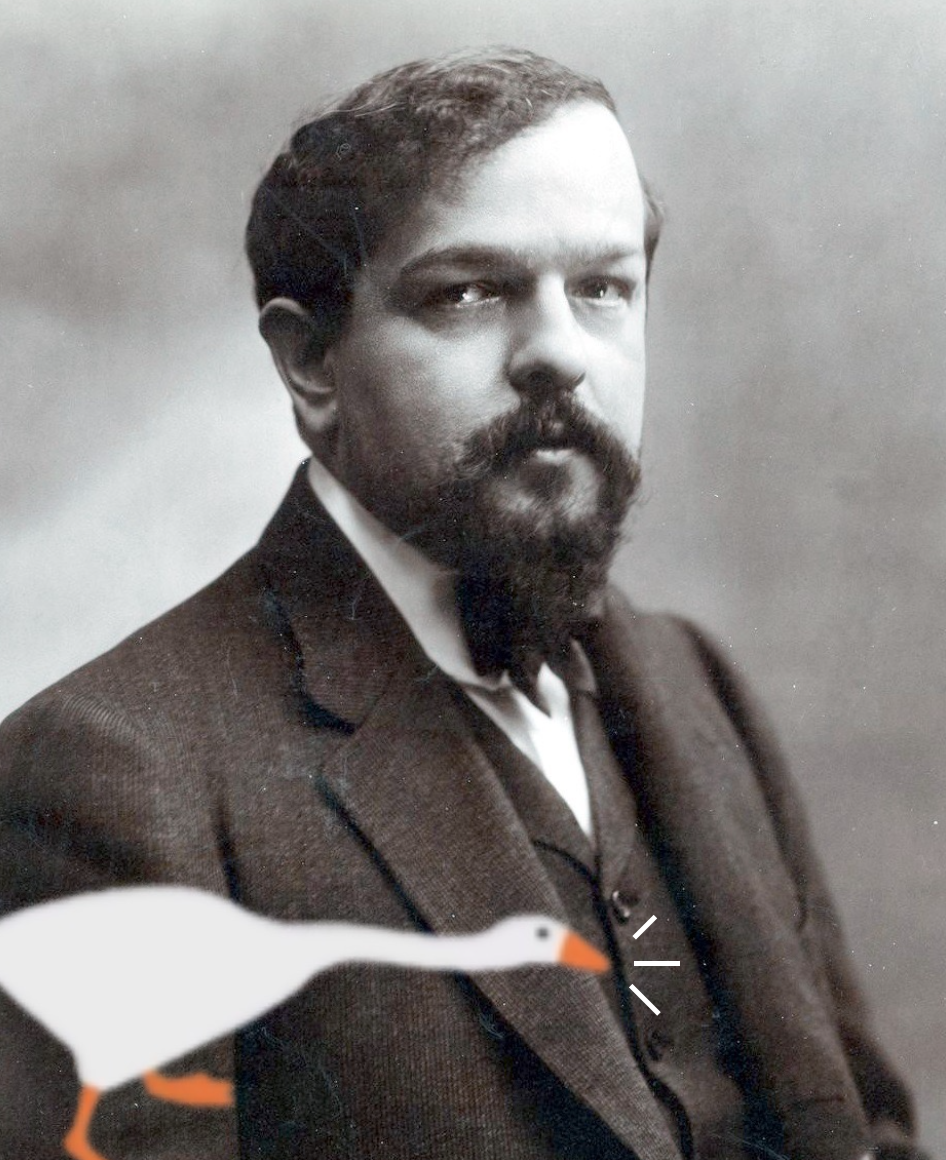
While the gameplay itself is relatively straightforward, the game’s dynamic soundtrack offers a compelling study in music and affect. Rather than composing an original soundtrack, the game developers borrowed selections from Claude Debussy’s Préludes (which are now in the public domain). Elements of urgency, surprise, movement, and mischief are infused into the existing music by altering its tempo, pulse, volume, and register. Composer Dan Golding describes the creative process in an interview with Paul Dougherty of Zoneout:

There are two performances of every Prélude on the soundtrack – one version that is similar to how you’d typically hear the music performed, and another which is slower and has lower energy. Both of these performances are chopped up into about 300 to 400 short fragments, each between one and three seconds long, that are queued to trigger in order.

The game then chooses which of the two versions to trigger depending on what the player is doing. And if the player is doing nothing, the soundtrack remains silent.

The game is comprised of five settings within an English village, each featuring a Prélude: The Garden (Minstrels*), High Street (Les Collines de Anacapri), the Back Gardens (Hommage à S. Pickwick, Esq. P. P. M. P. C.), The Pub (Le serenade interrompue), and the Model Village (Feux d’Artifice).

The differences between the original Préludes and their modified versions are most pronounced upon entering each world, when the goings on in the game are still relatively low-energy. Minstrels, for example, has a sense of ambiguity achieved by exaggerating Debussy’s instructions to hold back (cédez, which translates literally as “give up”) after each four-bar phrase. Golding expands upon this by hesitating between each 5-1 movement in the bass line (Example 1), momentarily denying our ears resolution.

Example 1 Minstrels

Example 1 Minstrels

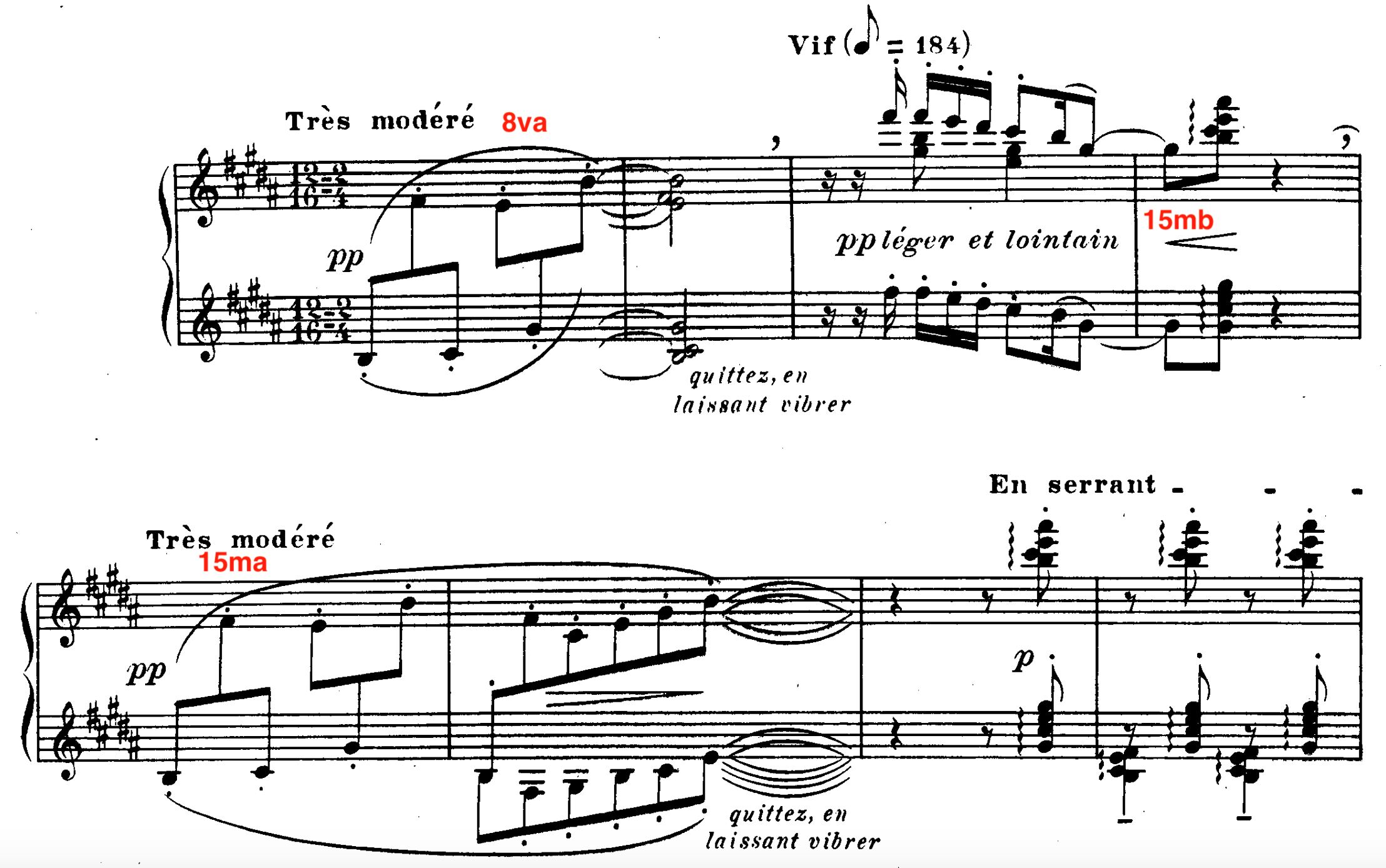
Similarly, when comparing the standard Les collines d’Anacapri to its in-game counterpart, the most obvious adaptation is the tempo, which Golding has dramatically reduced. The register has been altered, too. The opening figures have been raised an octave in some instances and lowered by an octave in others. The cumulative result is a contemplative mood reflective of a sleepy village yet to endure the goose’s undoing.

Example 2 Les collines d’Anacapri: changes made to register in Golding’s low-energy interpretation are marked in red.

Example 2 Les collines d’Anacapri: changes made to register in Golding’s low-energy interpretation are marked in red.

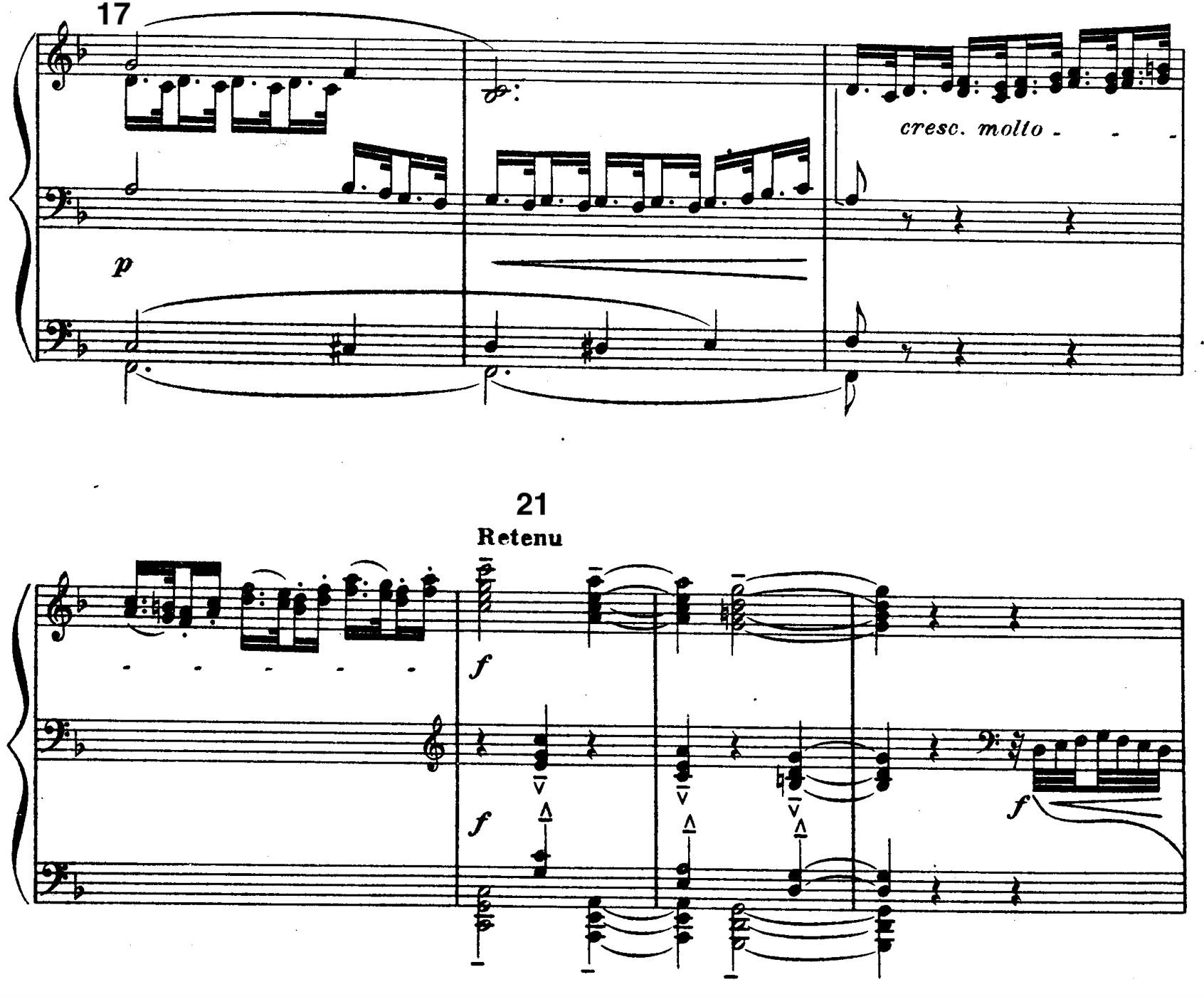
The phrasing in Golding’s low-energy interpretation is, in places, nearly inverse of the original. The first climax (m. 21) is treated as more of an afterthought than a point of arrival, trailing away in both pulse and volume. The dotted-sixteenth thirty-second motive (seen in m. 17 and throughout the piece), on the other hand, is voiced more emphatically than is typical, lending a sense of playful clumsiness.

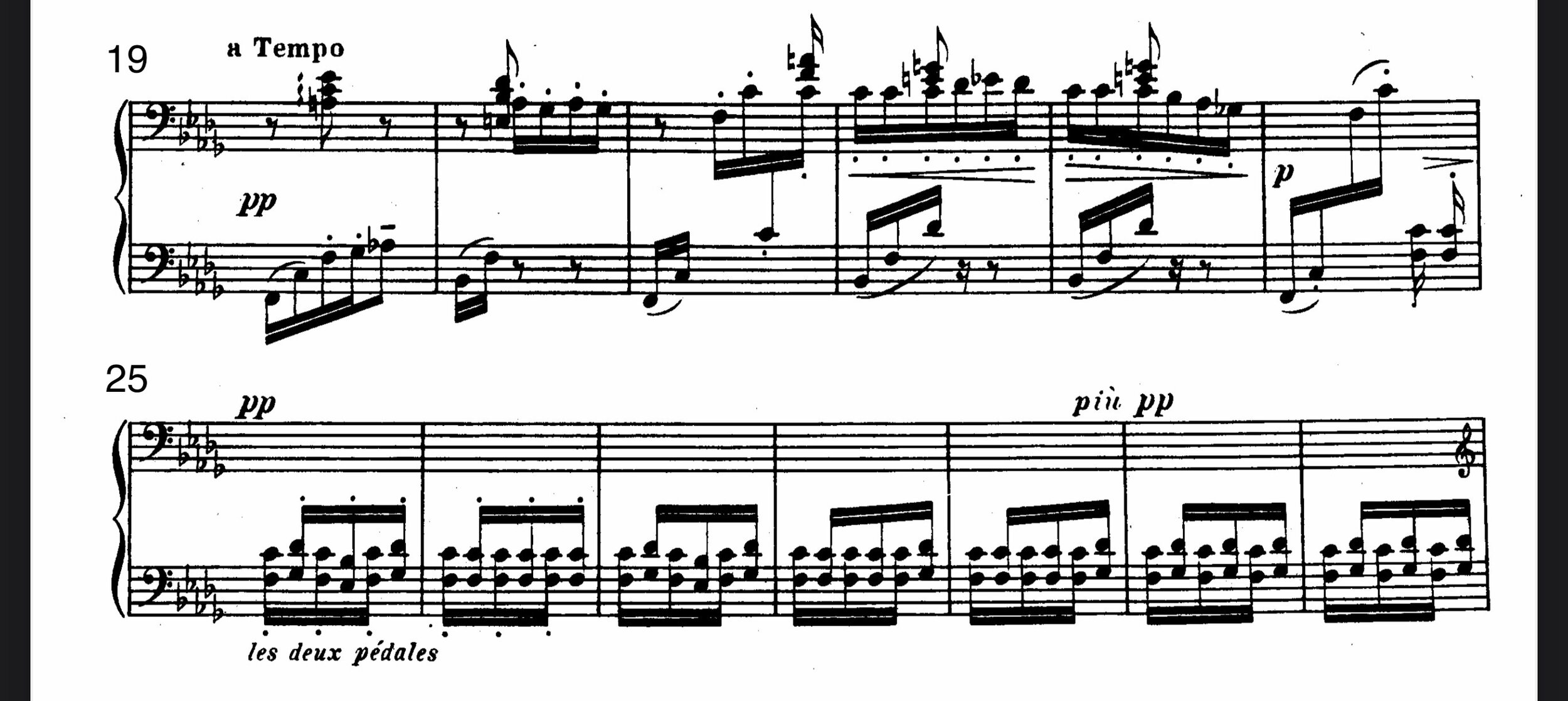
Example 3 Hommage à S. Pickwick, Esq. P. P. M. P. C.: m. 17 shows the dotted-sixteenth thirty-second note motive that recurs throughout the piece; Debussy’s instructions for the climax in m. 21.

Example 3 Hommage à S. Pickwick, Esq. P. P. M. P. C.: m. 17 shows the dotted-sixteenth thirty-second note motive that recurs throughout the piece; Debussy’s instructions for the climax in m. 21.

Le serenade interrompue: A Deep Dive

Le serenade interrompue, aside from a relaxed tempo, remains relatively unchanged until measure 62, when a caesura is added before a syncopated melody begins. Meant to imitate a Spanish guitar—Debussy’s instructions state quasi guitarra, or “like a guitar”—the texture and articulation suggest strumming (mm. 21-23) and plucking (the ostinato beginning in m. 25). However, when performed under tempo with a heavier articulation, the ostinato becomes bumbling and pervasive.

Example 4 Le serenade interrompue, with a strummed texture in the first system and a plucked texture in the next system.

Example 4 Le serenade interrompue, with a strummed texture in the first system and a plucked texture in the next system.

This Prélude is perhaps the most overtly programmatic of those used in the game’s soundtrack. It tells the story of one lover serenading another—but with interruptions that come not only through abrupt, brief changes in harmony and dynamics (mm. 46-49), but also through prolonged changes in style (mm. 80-84, and again in mm. 87-89). The longer “interruption” passages sound like background music within the musical world: yet another thing with which the guitarist must compete. In the context of the game, another layer of storytelling is added through the interrupting goose. Even without modifications, Le serenade interrompue tells a story.

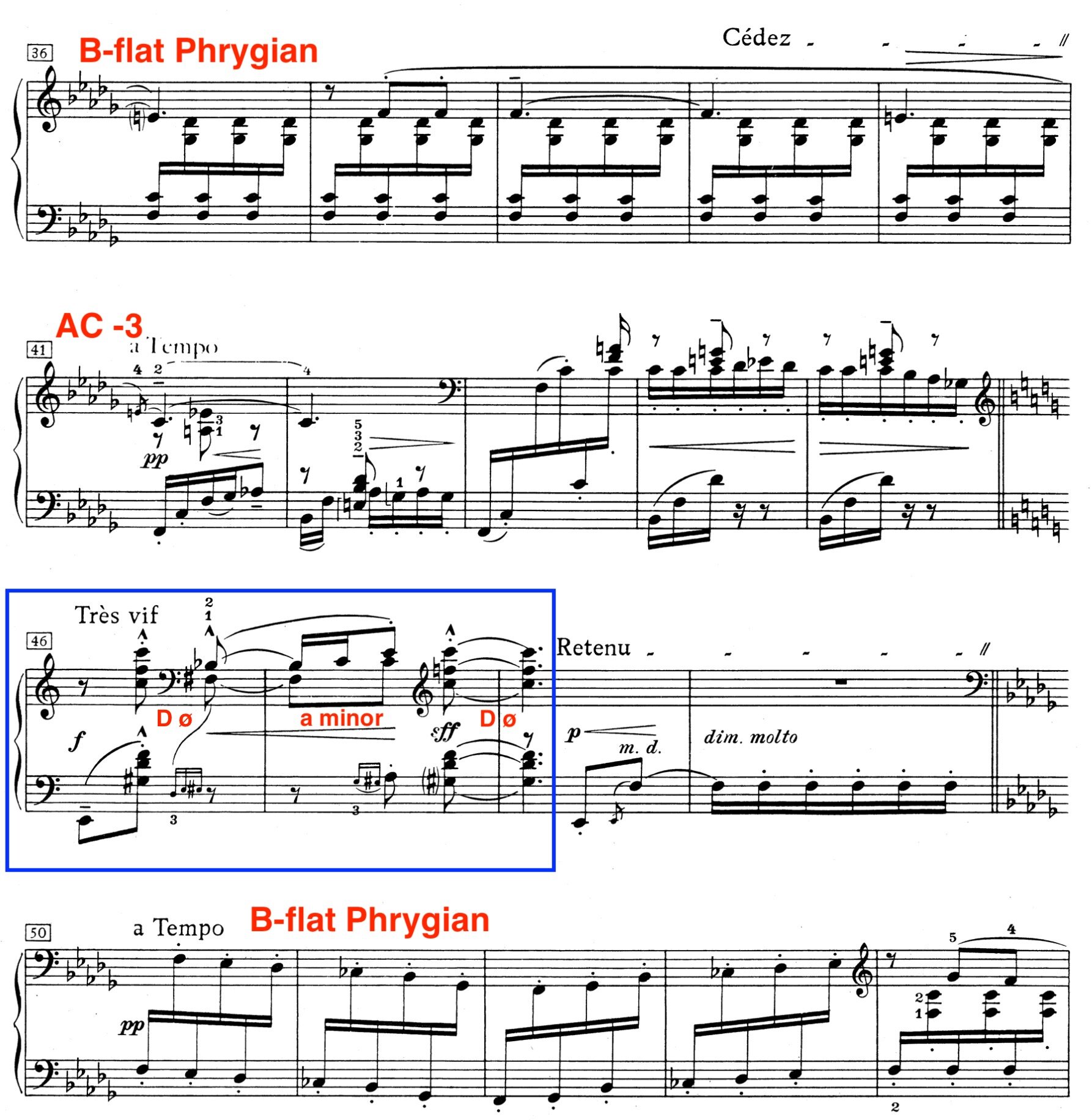
Example 5 Le serenade interrompue: The harmony changes abruptly from an acoustic collection (-3) to unrelated half-diminished chords, which might be interpreted a few different ways (that is beyond the scope of this blog post). Nonetheless, measures…

Example 5 Le serenade interrompue: The harmony changes abruptly from an acoustic collection (-3) to unrelated half-diminished chords, which might be interpreted a few different ways. The harmonic shift in mm. 46-47 is abrupt and striking, functioning clearly as interruption through harmony, texture, and dynamics.

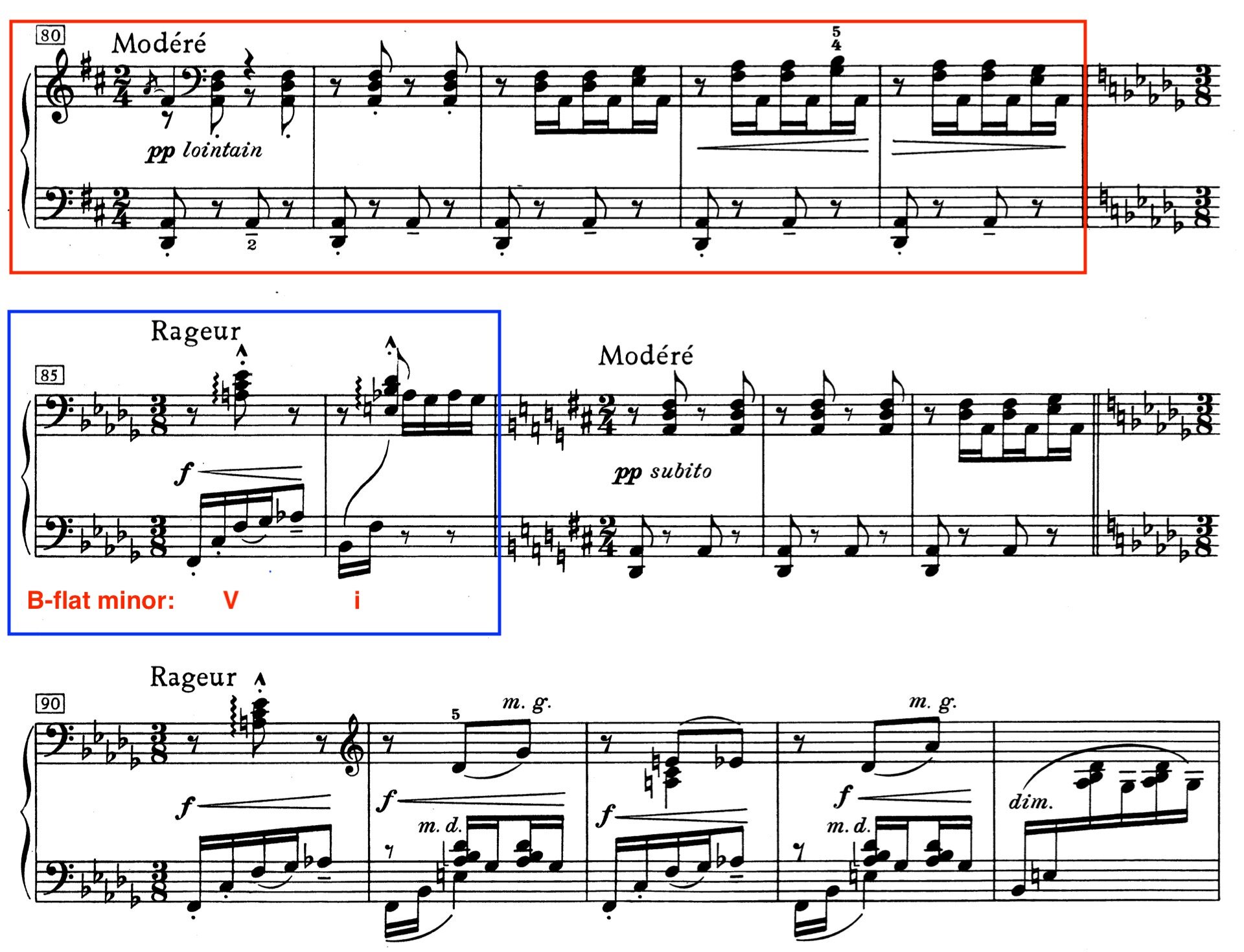
Example 6 Le serenade interrompue: Measures 80-84, clearly in D major, feature a march-like style not seen in any other section of the piece—the guitarist is competing with other music within his world. His sentiment toward this more prolonged inter…

Example 6 Le serenade interrompue: Measures 80-84, clearly in D major, feature a march-like style not seen in any other section of the piece—the guitarist is competing with other music within his world. His sentiment toward this more prolonged interruption shows in mm. 85-86, marked Rageur (furious). Golding’s interpretation places this interruption two octaves higher.

While exploring the individual alterations to each piece is interesting, it’s the instantaneous change in affect enabled by the juxtaposition of the altered and original versions that make the magic of the soundtrack. The player never hears the same combination of versions twice during gameplay.

Whether chosen deliberately or serendipitously, Debussy’s handling of titling makes the Préludes particularly well suited to a reactive soundtrack. Although Debussy gives interpretive instructions on the score—sometimes using standard musical terminology, but sometimes using descriptive phrases unique to a particular Prélude—no title is revealed until the end of the piece. This allows the listener to subjectively submerse themselves in the melodic, harmonic, textural, and even timbral elements that Debussy combines to create a soundscape. What we ultimately find to be titled Le serenade interrompue (“The Interrupted Serenade”) may have evoked different images for different listeners.

applications to piano pedagogy

Film and video game soundtracks can serve as powerful pedagogical tools, particularly when they already hold interest for students. What can we learn from reactive soundtracks? These are some thoughts that came to mind as I compared the Untitled Goose Game soundtrack to standard performances of the Préludes:

  • What effect does register, specifically, have on mood? Could students create a sense of atmosphere using only one pitch in different registers? This can serve as an accessible starting point for students who feel overwhelmed by improvisation.

  • What elements do composers manipulate to create different moods?

  • How would the mood of a piece change if we played certain elements—dynamics, articulations, tempo markings—oppositely? Taking a trip to what my young students and I call “Opposite Land” can also be a good way to make students more sensitive to a piece’s intended markings.

  • How do we know what a piece could be about without using the title as an influence?

It’s worth noting that we can give any piece the “Debussy treatment” by covering its title and having students imagine what the piece might be about—then compare their title to the original one. We can also turn any piece into the soundtrack to a story we create ourselves. Sonata-Allegro form, with themes of contrasting affect in the exposition and harmonic exploration in the development, lends itself especially well to storytelling. In smaller-scale teaching pieces like sonatinas (or other forms that don’t typically have imaginative titles) we might:

  • Associate dynamic levels or major/minor sonorities with a particular character.

  • Imagine different characters for the right and left hands.

  • Use formal sections to guide the story.

Storytelling through music is a topic of its own, but I found it impossible to discuss a reactive soundtrack (music to fit an ever-changing story) without at least touching upon the pedagogical tool of narrative (creating a story to fit music).

Although the soundtrack to Untitled Goose Game draws from the Western classical canon, it invites broader reflection on the pedagogical potential of video game music—classical or otherwise—as a creative and analytical tool.


A Note on Minstrels: Debussy’s Minstrels alludes to minstrelsy, a form of entertainment rooted in racist caricature and blackface performance. That historical context warrants thoughtful consideration in pedagogical settings.

When approaching repertoire with complicated or problematic associations, teachers have options. One approach is to focus on the technical and musical elements while selecting alternative repertoire that addresses similar concepts.

Another, particularly in the case of Debussy’s Préludes, is to invite students to engage imaginatively with the music independent of its title. Because Debussy placed each title at the end of the piece, listeners are already encouraged to form their own interpretive impressions before encountering the name.

In my own teaching, I most often choose alternative repertoire when similar pedagogical goals can be met elsewhere.

Perfect Practice: Part 1

Five foundational Habits for Stress-Free Practice

Most piano families understand that practice plays an essential role in progress. What is less clear is how practice should unfold at home. Like piano playing itself, practicing is a skill—one that develops gradually with guidance.

This post begins a Perfect Practice series (a nod to pedagogue Elvina Truman Pearce) and outlines several foundational habits that foster consistent, effective practice at home. The trick, ironically, is to aim for consistency over perfection. There is simply no such thing as truly perfect practice!

Practice Starts in the Lesson

Effective practice begins before the student ever leaves the lesson. In my teaching, practice strategies are introduced and modeled during lesson time. When expectations are clear, and students are confident that they can meet them, they practice more readily. For each assignment, students use specific techniques for at-home practice, and I have students replicate those techniques for me so I can be sure they will be successful at home.

For younger students, parent observation can be especially helpful. Some parents take notes; others record a short segment of the lesson for reference. Even occasional observation strengthens communication between teacher, student, and parent.

Choose a Time and Stick with It

A tried-and-true rule for productive at-home practice is following a routine. When treated as a negotiable part of the daily routine, piano practice often lands at the end of the day when both parents and students are too tired to be productive. Elvina Truman Pearce outlines this topic in The Success Factor in Music Teaching: Making Practice Perfect. She makes two great suggestions:

  • “trying out” different practice times (before or after school, before or after dinner, etc.) for at least five days each to see which one clicks best with everyone.

  • splitting up daily practice into two or three short sessions.

I promise this won’t be the case. ;) Source

I promise this won’t be the case. ;) Source

It’s important to note that, while practicing may happen at the same time each day, practice length may vary. I encourage students to use practice time wisely to ultimately spend less time practicing. There are certainly broad practice time suggestions for different age groups that are helpful for new piano students, but these are starting points—not rigid guidelines.

Create a Supportive Environment

The ideal practice environment sets the student up for success. Things to consider include:

  • Is the room quiet enough for focused listening?

  • Is the piano located away from heavy foot traffic?

  • Are materials organized and easily accessible?

When the environment reflects shared respect for practice time, students are more likely to value it as well.

The point is that if practice is to become important to the student and a regular part of [their] daily routine, then a suitable environment for it must be created and respected by the entire family. This indicates to the student that all members of the family respectfully support its importance.
— Elvina Pearce, The Success Factor in Piano Teaching: Making Practice Perfect (193)

Remember that Children are Still developing

Children are still learning to recognize and regulate their emotions and behaviors. They need patience and guidance as they learn the self-regulatory skills necessary to direct their behavior toward a goal. Self-regulation includes a complex set of abilities developed gradually from infancy through middle-childhood (up to around age 12) (Ziv et al. 2017). For piano students, self-regulating includes planning practice, changing the plan if something isn’t working, and thinking about what went well and what didn’t. That’s a lot of work for a developing brain!

It is both normal and expected for younger students to need reminders, structure, and encouragement—even when they genuinely enjoy piano. There will be strong practice days and challenging ones. Understanding this helps parents respond with patience and realistic expectations.

Deep Dive: freedom within a framework

As students mature, independent, self-motivated at-home practice is an important goal. Experts agree that autonomy plays a significant role in motivation (Gandhimathi & Anitha Devi, 2016). The meaning of autonomy is twofold. In an educational sense, it refers to students’ ability to guide their learning; in general, it can refer to independence or freedom.

We can think of both definitions of autonomy as two unique components that work together. For students to be interested in their learning process (autonomy), they need to feel in control of their goals (through freedom and choice).

Who makes most of the choices in the context of piano lessons? Parents of younger students usually decide when practice happens; the teacher decides which practice techniques to use (or how) to practice; method books, even when supplemented with outside music, can largely dictate what is practiced. While it’s essential to keep a steady and organized practice routine, it’s equally important to allow students to have a say in their learning. Some strategies for providing choice and facilitating independence include:

  • allowing the student to plan the order of tasks within their practice session.

  • incorporating improvisation into every practice session.

  • using tools that help students keep track of meaningful repetition independently (see example below).

  • encouraging the student to reflect on their progress.

  • asking the student which practice assignment they feel needs the most attention.

  • encouraging the student to keep track of questions that arise during practice.

FullSizeRender-2.jpeg
Use Iwako erasers to track repetition—each time the student plays the target passage correctly, move an eraser to the other side of the music stand.

Use Iwako erasers to track repetition—each time the student plays the target passage correctly, move an eraser to the other side of the music stand.


The next Perfect Practice installment will explore practice attitudes, how to deal with difficult practice days, and thoughtful use of reward systems.


Sources

Gandhimathi, S., & Anitha Devi, V. (2016). Learner Autonomy and Motivation - A Literature Review. Research on Humanities and Social Sciences, 6(3). https://core.ac.uk/download/pdf/234674899.pdf

Pearce, E., Sale, C., & Blickenstaff, M. (2014). The success factor in piano teaching: Making practice perfect. Kingston, NJ: The Frances Clark Center for Keyboard Pedagogy.

Ziv, Yair & Benita, Moti & Sofri, Inbar. (2017). Self-Regulation in Childhood: A Developmental Perspective

The Art of Marking Music

A skill of its own!

Marking music with purpose and clarity makes for more efficient lessons and practicing. Perfecting this art has been an ongoing goal of mine.

The Issue

Piano teachers are in a constant race against time—there’s so much content to fit in during the 30-60 minutes per week that we see a given student. I am in never-ending pursuit of spending less time talking and writing down assignments and more time making music! Throughout this journey, I’ve found myself returning to two questions:

  • How can we actually engage with what we mark on the page?

  • Are assignment sheets truly helpful? If so, how can they be more practical?

Over time, I’ve realized that I’m most comfortable and at my best when I understand the exact purpose behind what I’m doing in a lesson. If I’m going to invest time in a system, I want to refine it so that it clearly supports the student’s progress. Ultimately, I want to spend less time writing instructions and more time making music. Thoughtful score markings help make that possible.

Why do we mark our music?

A marking is a call to action. It signals that something deserves attention. When I reflect on the markings my students and I make, they generally fall into a few categories:

  • To analyze

  • To encourage phrasing

  • To prevent mistakes

  • To reinforce a new concept

  • To give meaning to an abstract concept

  • To guide practice

How Students Interact with Their Scores

I think of markings along two independent spectrums:

  • Passive vs. Active

  • Fixed vs. Flexible

The first describes how a student engages with a marking in the moment (usually during the lesson). The second describes how the marking functions over time (usually during practice at home).

Passive vs. Active

Passive markings are teacher-driven: I circle something, I write an instruction, I highlight an error.

Active markings invite student ownership—the student identifies the issue, makes the mark, and engages with the solution. When students interact with their scores directly, they begin thinking like musicians rather than simply following directions.

Fixed vs. Flexible

Fixed markings stay on the page. Examples include:

  • Circling accidentals

  • Labeling formal sections

  • Marking harmonic events

Flexible markings evolve over time. They are moveable, removable, stackable—the list goes on. I like to use removable highlighter tape, but I have also used erasable colored pencils. The goal is that flexible markings be eye-catching, engaging, and fun.

Glenn Gould’s score to Bach’s Goldberg Variations. (Source)

Glenn Gould’s score to Bach’s Goldberg Variations. (Source)

More About Flexible Markings

Flexible markings are especially helpful for:

  • sudden dynamic changes

  • sudden position changes

  • practice strategies for particular sections of music

  • errors made in a run-through of a piece

  • places where memory slips occurred if a student is working toward memorization

In these situations, I use flexible markings for a few reasons:

  • The tape can be removed when the student solves a problem. Errors can also be highlighted again in another color to show that a concept still needs another week of practice. Asking students if they think the tape is ready to be removed also sets the tone for self-evaluation.

  • Visual clutter doesn’t accumulate over the weeks. Students won’t likely practice the same way each week; practice techniques can be swapped in and out.

  • Students love taking ownership of their scores by choosing colors and applying tape on their own. Even my high schoolers enjoy picking the week’s tape color.

How does this relate to practicing?

If we expect students to practice independently, these conditions must be met:

  • The teacher has shown the student how to practice their material in the lesson.

  • The student has successfully replicated the practice techniques more than once in the lesson, under teacher supervision.

  • There is a clear, concise explanation of these techniques where the student can review them, like a practice notebook—or, better yet, right on the score where they require fewer steps to access.

Therefore, thoughtful, intentional, and dynamic markings that extend the practice notebook onto the score in an engaging way can be considered a student motivator. When we know what to do and how to do it, we’re more likely to take action!


Examples

Burgmüller Op. 100, No. 9: The Chase

Here, we have a few flexible markings that outline which practice technique to use in specific passages.

O.F. = on the fallboard

G.P. = ghost practicing

S/P = stop/prepare

Burgmuller Example.jpg

I don’t always use abbreviations, especially with younger students. Practice technique shortcuts like these are only useful if the student knows what they mean and how to execute them, so I write more detailed instructions in an assignment book, if necessary.


Kabalevsky Op. 27 No. 13: A Little Joke

Since different practice techniques will be used to master the rapid position changes and left-hand speed and clarity, this passage is a great place to use flexible markings.

B.P. = blocked practice, with circled notes practiced together in a “block” to aid with the rapid position changes in the notorious B section of this piece.

Kabalevsky Example.jpg

Rachmaninoff Prelude in G-sharp Minor, Op. 32 No. 12

I wanted to include an example using fixed markings to illustrate the potential for creativity; fixed markings don’t have to be passive circles on the score. Here, I’ve quantified the gradual crescendo (an otherwise abstract concept) that begins in the first measure of this page. This activity is a great opportunity for advanced students to listen to recordings of concert pianists, observe the artists’ varying interpretive decisions about the crescendo, and decide for themselves how and when the volume will increase in their personal interpretation of the piece.

Rachmaninoff Example.jpg

The Takeaway

The marks we make on our scores can be active or passive, fixed or flexible. When we are intentional about those choices, our expectations become clearer and our teaching becomes more efficient.

When students know what to do and how to do it, practicing feels more manageable. Whenever possible, students should participate in marking their own scores so that they develop ownership of their music.

Flexible markings, in particular, allow students to track progress without cluttering the page. They encourage reflection, reinforce strategies, and support steady growth over time.