The Parent's Guide to Rote Pieces: Part 1

What is rote teaching?

Rote pieces are intended to be learned by imitation. Although the score (music on the page) to every rote piece can be found in the Piano Safari repertoire books, students practice rote pieces by using their ears, reminder videos, and various manipulatives that provide a visual representation of the piece.

For some adults, the word rote may bring back memories of memorizing information without much engagement. In a musical context, however, rote learning is something quite different. When guided thoughtfully, it is an intentional and highly effective way to introduce musical concepts.

Why learn music by rote?

By the time children begin piano lessons, they have been exposed to music in a multitude of genres, styles, and settings; rote learning allows students to access complex, expressive music before they are fluent readers of notation. Just as children learn to talk before they can read words, they can also learn to hear, feel, and execute musical concepts with proper technique before seeing and processing written symbols.

Some other benefits of rote learning include:

  • Rote pieces often use the full range of the keyboard, which feels exciting and motivating.

  • Without the cognitive load of note-reading, students can focus fully on healthy technique.

  • Students become comfortable playing both with and without music in front of them, which prepares them for memorized performance later.

  • Hearing and feeling patterns first supports stronger reading skills in the future. When students encounter those patterns on the page, they already recognize them physically and aurally.

For further reading on the benefits of rote teaching, check out Dr. Julie Knerr and Katherine Fisher’s essay.

The Basic Rote Learning Process

All of my students—from preschoolers to retirees—learn by rote in addition to learning to read notes on the staff. The practice process for rote pieces, while not more difficult, is different from what parents and students might consider traditional practice. To clarify the process, I’ve created a basic guide to practice.

We learn rote pieces in our lesson; a rote piece will rarely be a YOYO (You’re on Your Own) piece. Students listen to rote pieces for a week or two before they’re taught to play them. This means that students will occasionally have a listening assignment to do at home.

To practice rote pieces at home, students should use the following steps:

  1. Listen multiple times. Students should sing, move, and engage with the recording. (The Piano Safari method includes downloadable recordings for each piece.)

  2. Refer to the score for starting position and lyrics. There is no need to read individual notes. Students may notice broad patterns like the notes moving up or down—this kind of observation is encouraged. Keeping the score visible helps notation feel familiar over time.

  3. Try to play the piece using strategies taught in the lesson before using the reminder video. These could include visual aids in the method book, printable cards, or breaking the piece into small sections.

  4. Review reminder videos as needed. Even if a piece feels secure, reviewing ensures correct fingerings and technical gestures.

Students use pictures to help remember the form and dynamics of longer rote pieces. They can be printed at home for free.

Longer rote pieces use picture cards to aid memory.


Looking Ahead

Future posts in this series will explore the details of each practice step more thoroughly, including how to listen actively, how to break pieces into manageable sections, and how parents can guide their young pianist during home practice.
Untitled Goose Game and the Magic of Reactive Soundtracks

It’s a lovely morning in the village, and you’re a horrible goose.

That is, in a nutshell, the premise of Untitled Goose Game, a “slapstick-stealth-sandbox” puzzle game released by House House in 2019. The player assumes the role of a goose, who uses its limited physical abilities and the manipulation of objects within its world to unlock achievements—all of which involve pestering unsuspecting townspeople.

le honk.png

Le honk.

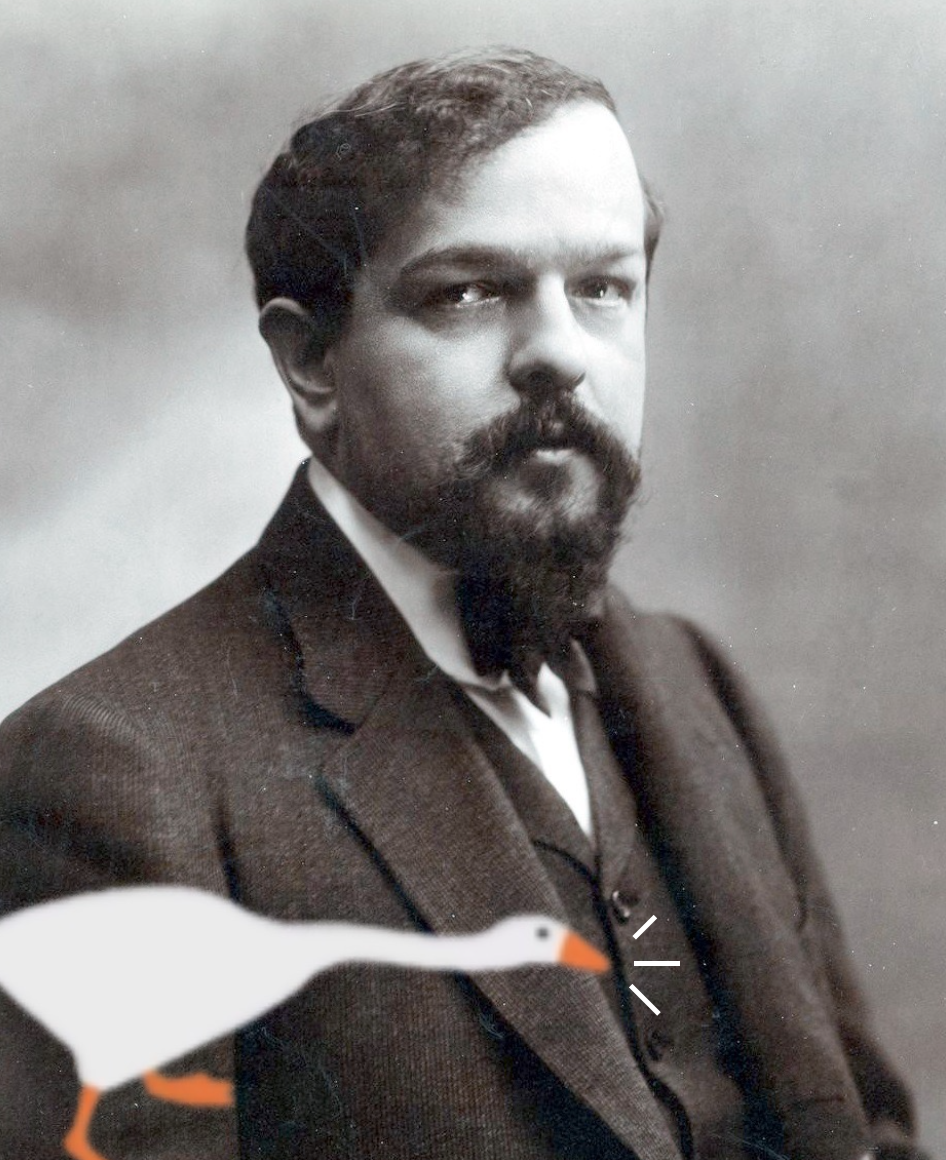
While the gameplay itself is relatively straightforward, the game’s dynamic soundtrack offers a compelling study in music and affect. Rather than composing an original soundtrack, the game developers borrowed selections from Claude Debussy’s Préludes (which are now in the public domain). Elements of urgency, surprise, movement, and mischief are infused into the existing music by altering its tempo, pulse, volume, and register. Composer Dan Golding describes the creative process in an interview with Paul Dougherty of Zoneout:

There are two performances of every Prélude on the soundtrack – one version that is similar to how you’d typically hear the music performed, and another which is slower and has lower energy. Both of these performances are chopped up into about 300 to 400 short fragments, each between one and three seconds long, that are queued to trigger in order.

The game then chooses which of the two versions to trigger depending on what the player is doing. And if the player is doing nothing, the soundtrack remains silent.

The game is comprised of five settings within an English village, each featuring a Prélude: The Garden (Minstrels*), High Street (Les Collines de Anacapri), the Back Gardens (Hommage à S. Pickwick, Esq. P. P. M. P. C.), The Pub (Le serenade interrompue), and the Model Village (Feux d’Artifice).

The differences between the original Préludes and their modified versions are most pronounced upon entering each world, when the goings on in the game are still relatively low-energy. Minstrels, for example, has a sense of ambiguity achieved by exaggerating Debussy’s instructions to hold back (cédez, which translates literally as “give up”) after each four-bar phrase. Golding expands upon this by hesitating between each 5-1 movement in the bass line (Example 1), momentarily denying our ears resolution.

Example 1 Minstrels

Example 1 Minstrels

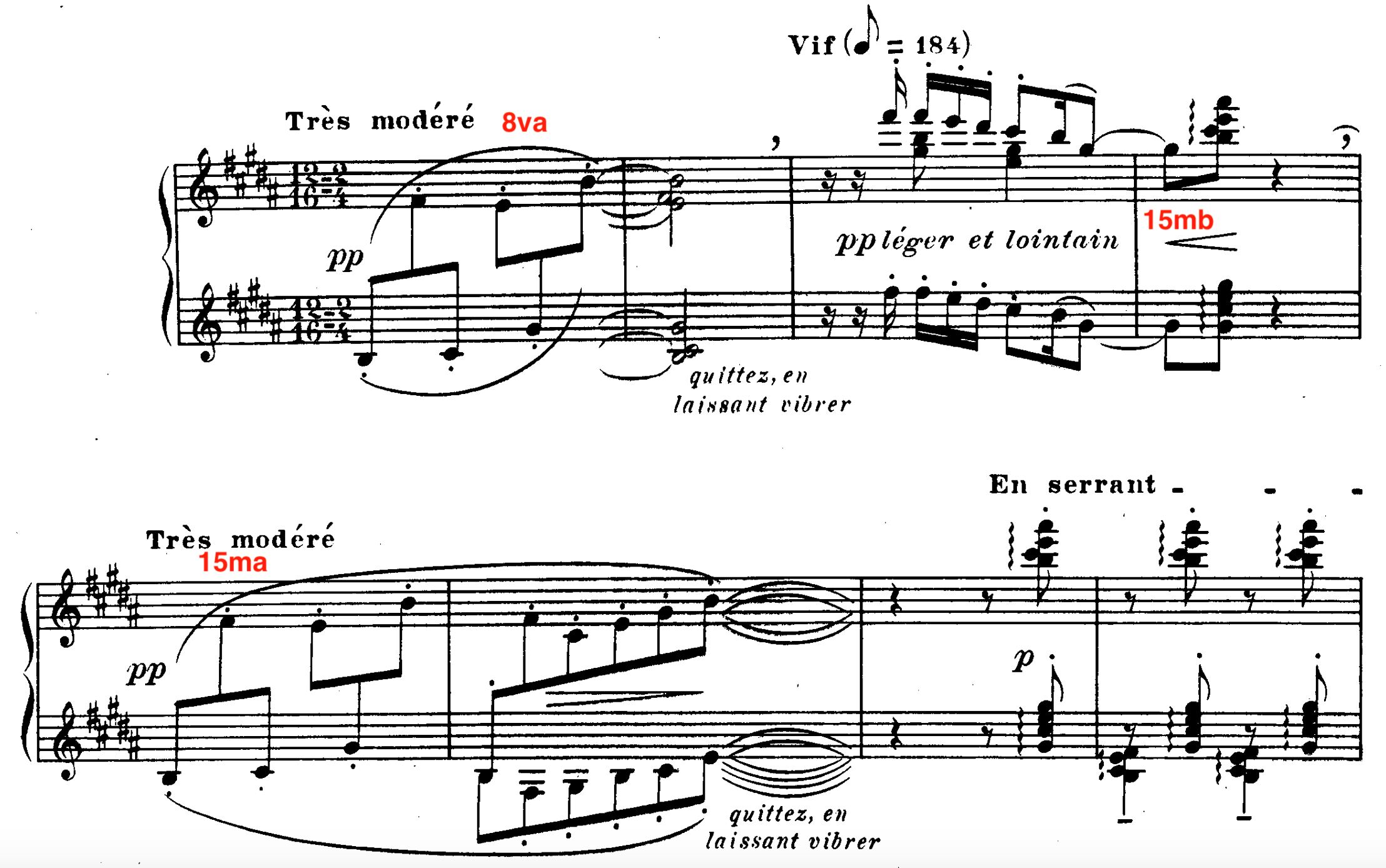
Similarly, when comparing the standard Les collines d’Anacapri to its in-game counterpart, the most obvious adaptation is the tempo, which Golding has dramatically reduced. The register has been altered, too. The opening figures have been raised an octave in some instances and lowered by an octave in others. The cumulative result is a contemplative mood reflective of a sleepy village yet to endure the goose’s undoing.

Example 2 Les collines d’Anacapri: changes made to register in Golding’s low-energy interpretation are marked in red.

Example 2 Les collines d’Anacapri: changes made to register in Golding’s low-energy interpretation are marked in red.

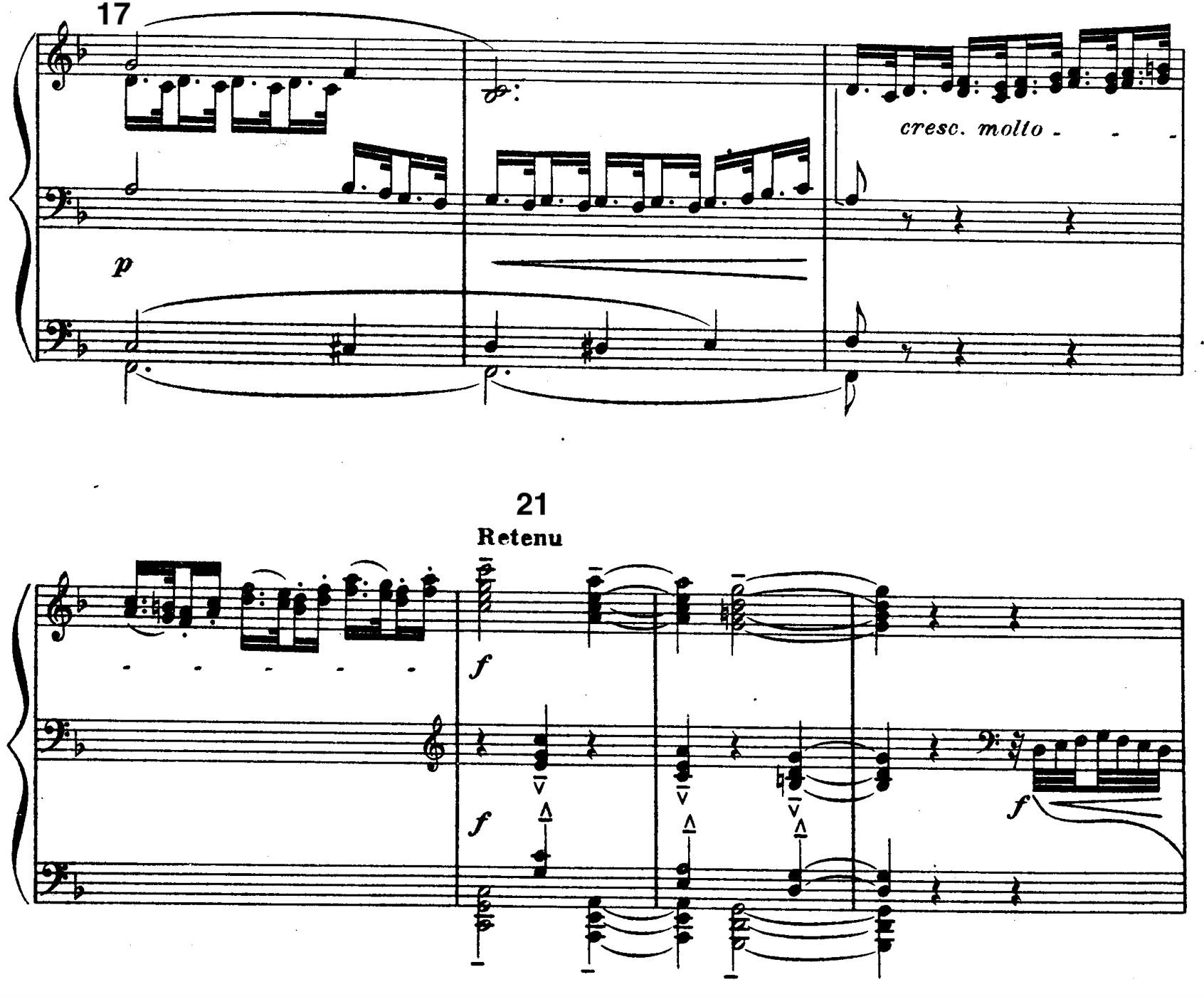
The phrasing in Golding’s low-energy interpretation is, in places, nearly inverse of the original. The first climax (m. 21) is treated as more of an afterthought than a point of arrival, trailing away in both pulse and volume. The dotted-sixteenth thirty-second motive (seen in m. 17 and throughout the piece), on the other hand, is voiced more emphatically than is typical, lending a sense of playful clumsiness.

Example 3 Hommage à S. Pickwick, Esq. P. P. M. P. C.: m. 17 shows the dotted-sixteenth thirty-second note motive that recurs throughout the piece; Debussy’s instructions for the climax in m. 21.

Example 3 Hommage à S. Pickwick, Esq. P. P. M. P. C.: m. 17 shows the dotted-sixteenth thirty-second note motive that recurs throughout the piece; Debussy’s instructions for the climax in m. 21.

Le serenade interrompue: A Deep Dive

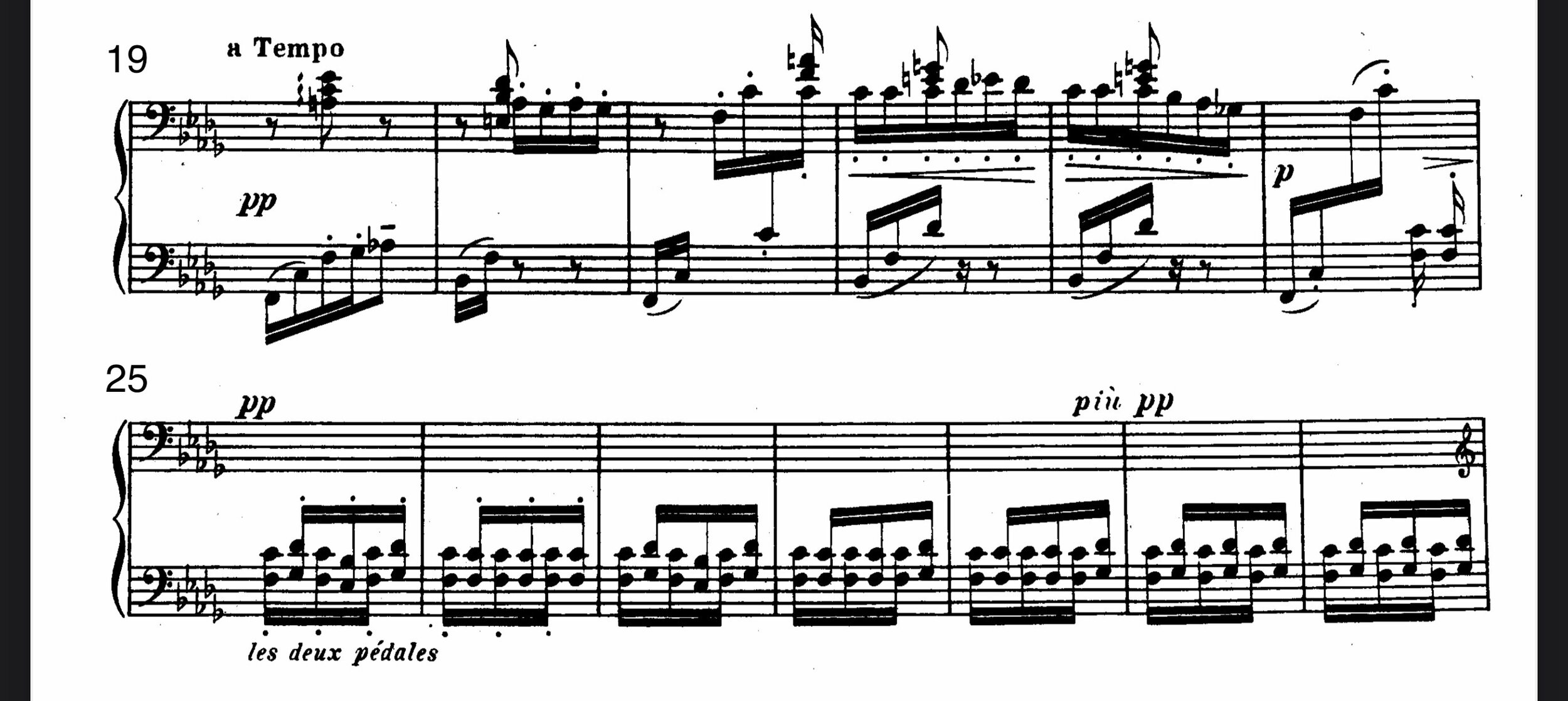
Le serenade interrompue, aside from a relaxed tempo, remains relatively unchanged until measure 62, when a caesura is added before a syncopated melody begins. Meant to imitate a Spanish guitar—Debussy’s instructions state quasi guitarra, or “like a guitar”—the texture and articulation suggest strumming (mm. 21-23) and plucking (the ostinato beginning in m. 25). However, when performed under tempo with a heavier articulation, the ostinato becomes bumbling and pervasive.

Example 4 Le serenade interrompue, with a strummed texture in the first system and a plucked texture in the next system.

Example 4 Le serenade interrompue, with a strummed texture in the first system and a plucked texture in the next system.

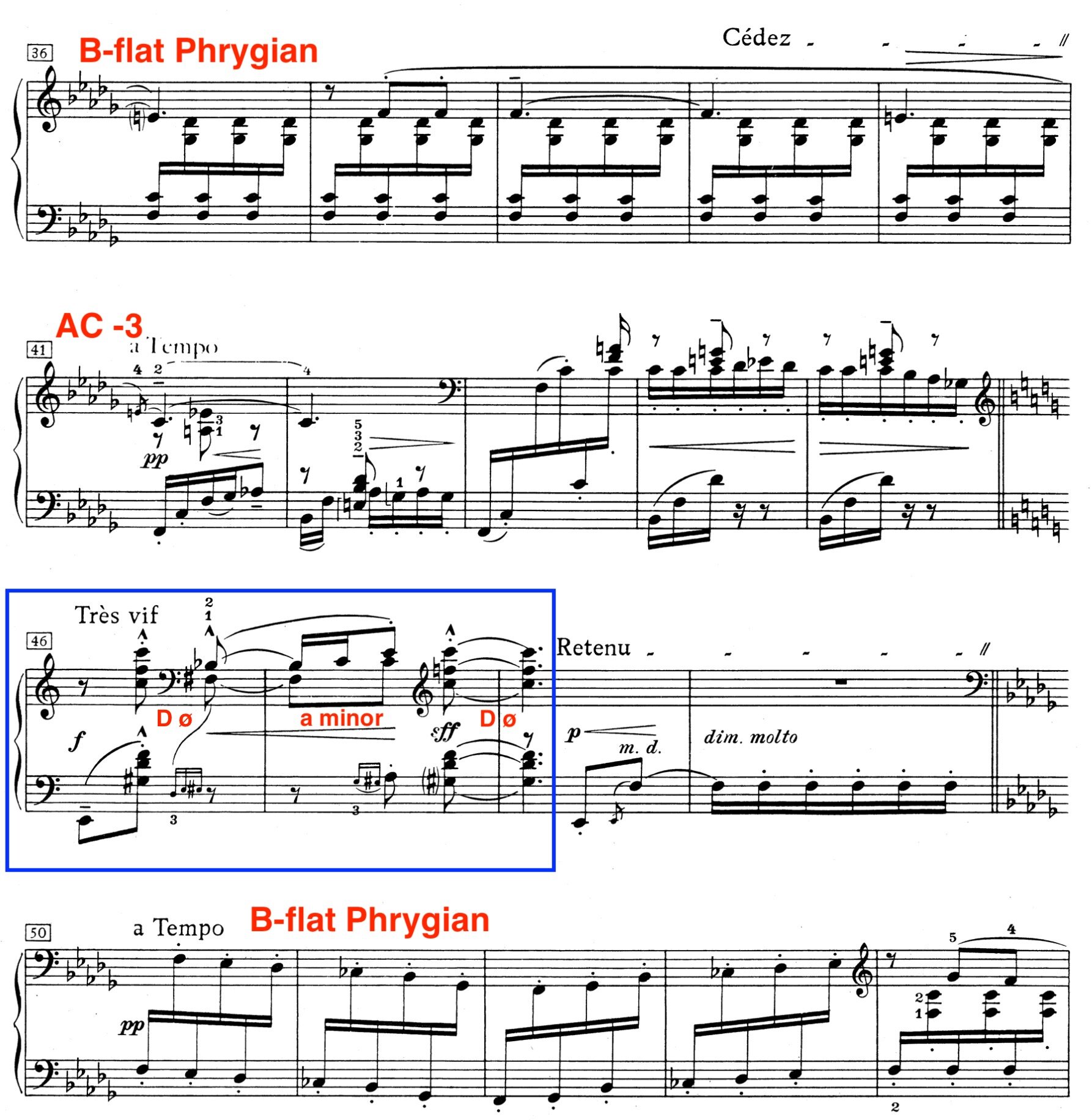
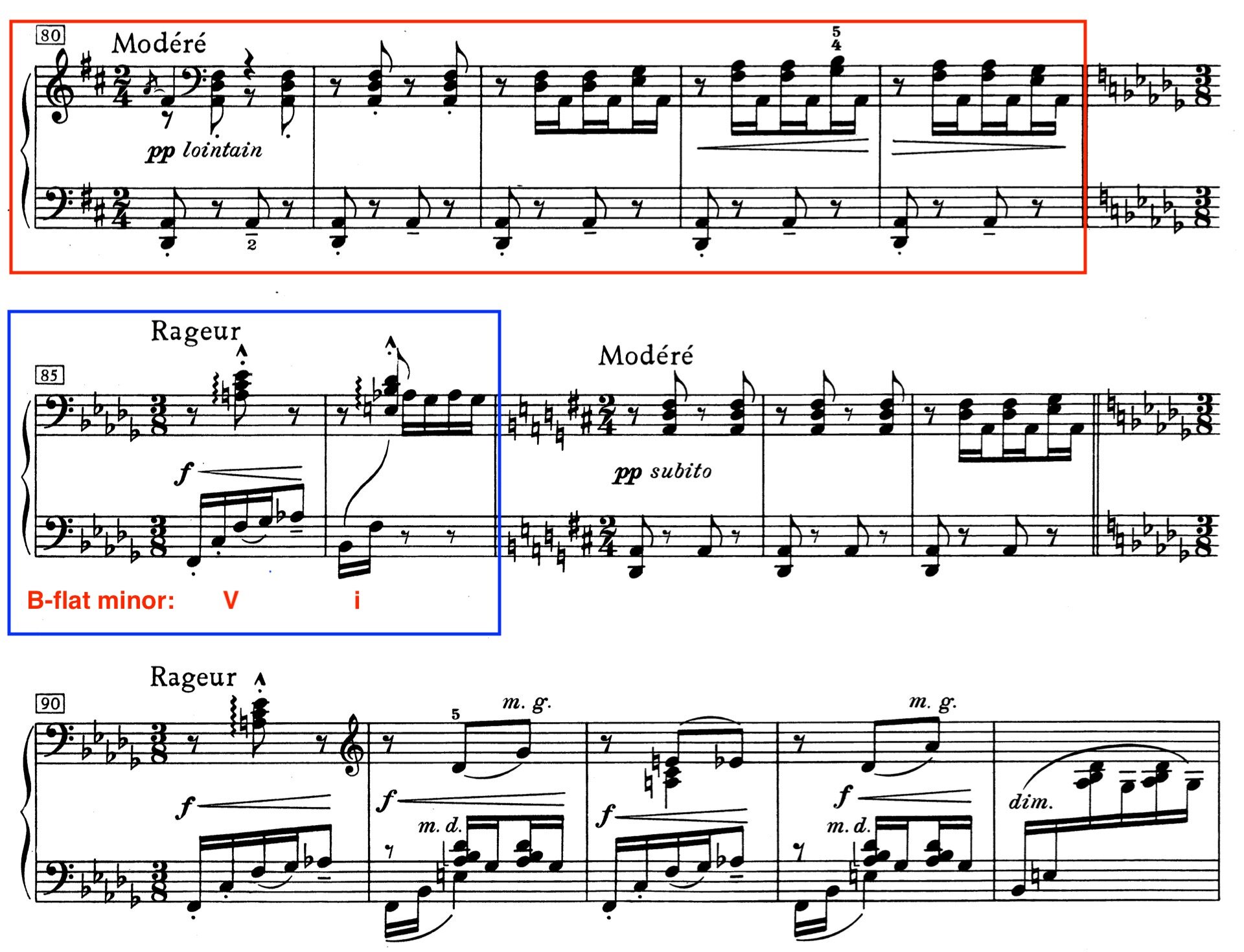
This Prélude is perhaps the most overtly programmatic of those used in the game’s soundtrack. It tells the story of one lover serenading another—but with interruptions that come not only through abrupt, brief changes in harmony and dynamics (mm. 46-49), but also through prolonged changes in style (mm. 80-84, and again in mm. 87-89). The longer “interruption” passages sound like background music within the musical world: yet another thing with which the guitarist must compete. In the context of the game, another layer of storytelling is added through the interrupting goose. Even without modifications, Le serenade interrompue tells a story.

Example 5 Le serenade interrompue: The harmony changes abruptly from an acoustic collection (-3) to unrelated half-diminished chords, which might be interpreted a few different ways (that is beyond the scope of this blog post). Nonetheless, measures…

Example 5 Le serenade interrompue: The harmony changes abruptly from an acoustic collection (-3) to unrelated half-diminished chords, which might be interpreted a few different ways. The harmonic shift in mm. 46-47 is abrupt and striking, functioning clearly as interruption through harmony, texture, and dynamics.

Example 6 Le serenade interrompue: Measures 80-84, clearly in D major, feature a march-like style not seen in any other section of the piece—the guitarist is competing with other music within his world. His sentiment toward this more prolonged inter…

Example 6 Le serenade interrompue: Measures 80-84, clearly in D major, feature a march-like style not seen in any other section of the piece—the guitarist is competing with other music within his world. His sentiment toward this more prolonged interruption shows in mm. 85-86, marked Rageur (furious). Golding’s interpretation places this interruption two octaves higher.

While exploring the individual alterations to each piece is interesting, it’s the instantaneous change in affect enabled by the juxtaposition of the altered and original versions that make the magic of the soundtrack. The player never hears the same combination of versions twice during gameplay.

Whether chosen deliberately or serendipitously, Debussy’s handling of titling makes the Préludes particularly well suited to a reactive soundtrack. Although Debussy gives interpretive instructions on the score—sometimes using standard musical terminology, but sometimes using descriptive phrases unique to a particular Prélude—no title is revealed until the end of the piece. This allows the listener to subjectively submerse themselves in the melodic, harmonic, textural, and even timbral elements that Debussy combines to create a soundscape. What we ultimately find to be titled Le serenade interrompue (“The Interrupted Serenade”) may have evoked different images for different listeners.

applications to piano pedagogy

Film and video game soundtracks can serve as powerful pedagogical tools, particularly when they already hold interest for students. What can we learn from reactive soundtracks? These are some thoughts that came to mind as I compared the Untitled Goose Game soundtrack to standard performances of the Préludes:

  • What effect does register, specifically, have on mood? Could students create a sense of atmosphere using only one pitch in different registers? This can serve as an accessible starting point for students who feel overwhelmed by improvisation.

  • What elements do composers manipulate to create different moods?

  • How would the mood of a piece change if we played certain elements—dynamics, articulations, tempo markings—oppositely? Taking a trip to what my young students and I call “Opposite Land” can also be a good way to make students more sensitive to a piece’s intended markings.

  • How do we know what a piece could be about without using the title as an influence?

It’s worth noting that we can give any piece the “Debussy treatment” by covering its title and having students imagine what the piece might be about—then compare their title to the original one. We can also turn any piece into the soundtrack to a story we create ourselves. Sonata-Allegro form, with themes of contrasting affect in the exposition and harmonic exploration in the development, lends itself especially well to storytelling. In smaller-scale teaching pieces like sonatinas (or other forms that don’t typically have imaginative titles) we might:

  • Associate dynamic levels or major/minor sonorities with a particular character.

  • Imagine different characters for the right and left hands.

  • Use formal sections to guide the story.

Storytelling through music is a topic of its own, but I found it impossible to discuss a reactive soundtrack (music to fit an ever-changing story) without at least touching upon the pedagogical tool of narrative (creating a story to fit music).

Although the soundtrack to Untitled Goose Game draws from the Western classical canon, it invites broader reflection on the pedagogical potential of video game music—classical or otherwise—as a creative and analytical tool.


A Note on Minstrels: Debussy’s Minstrels alludes to minstrelsy, a form of entertainment rooted in racist caricature and blackface performance. That historical context warrants thoughtful consideration in pedagogical settings.

When approaching repertoire with complicated or problematic associations, teachers have options. One approach is to focus on the technical and musical elements while selecting alternative repertoire that addresses similar concepts.

Another, particularly in the case of Debussy’s Préludes, is to invite students to engage imaginatively with the music independent of its title. Because Debussy placed each title at the end of the piece, listeners are already encouraged to form their own interpretive impressions before encountering the name.

In my own teaching, I most often choose alternative repertoire when similar pedagogical goals can be met elsewhere.

Perfect Practice: Part 1

Five foundational Habits for Stress-Free Practice

Most piano families understand that practice plays an essential role in progress. What is less clear is how practice should unfold at home. Like piano playing itself, practicing is a skill—one that develops gradually with guidance.

This post begins a Perfect Practice series (a nod to pedagogue Elvina Truman Pearce) and outlines several foundational habits that foster consistent, effective practice at home. The trick, ironically, is to aim for consistency over perfection. There is simply no such thing as truly perfect practice!

Practice Starts in the Lesson

Effective practice begins before the student ever leaves the lesson. In my teaching, practice strategies are introduced and modeled during lesson time. When expectations are clear, and students are confident that they can meet them, they practice more readily. For each assignment, students use specific techniques for at-home practice, and I have students replicate those techniques for me so I can be sure they will be successful at home.

For younger students, parent observation can be especially helpful. Some parents take notes; others record a short segment of the lesson for reference. Even occasional observation strengthens communication between teacher, student, and parent.

Choose a Time and Stick with It

A tried-and-true rule for productive at-home practice is following a routine. When treated as a negotiable part of the daily routine, piano practice often lands at the end of the day when both parents and students are too tired to be productive. Elvina Truman Pearce outlines this topic in The Success Factor in Music Teaching: Making Practice Perfect. She makes two great suggestions:

  • “trying out” different practice times (before or after school, before or after dinner, etc.) for at least five days each to see which one clicks best with everyone.

  • splitting up daily practice into two or three short sessions.

I promise this won’t be the case. ;) Source

I promise this won’t be the case. ;) Source

It’s important to note that, while practicing may happen at the same time each day, practice length may vary. I encourage students to use practice time wisely to ultimately spend less time practicing. There are certainly broad practice time suggestions for different age groups that are helpful for new piano students, but these are starting points—not rigid guidelines.

Create a Supportive Environment

The ideal practice environment sets the student up for success. Things to consider include:

  • Is the room quiet enough for focused listening?

  • Is the piano located away from heavy foot traffic?

  • Are materials organized and easily accessible?

When the environment reflects shared respect for practice time, students are more likely to value it as well.

The point is that if practice is to become important to the student and a regular part of [their] daily routine, then a suitable environment for it must be created and respected by the entire family. This indicates to the student that all members of the family respectfully support its importance.
— Elvina Pearce, The Success Factor in Piano Teaching: Making Practice Perfect (193)

Remember that Children are Still developing

Children are still learning to recognize and regulate their emotions and behaviors. They need patience and guidance as they learn the self-regulatory skills necessary to direct their behavior toward a goal. Self-regulation includes a complex set of abilities developed gradually from infancy through middle-childhood (up to around age 12) (Ziv et al. 2017). For piano students, self-regulating includes planning practice, changing the plan if something isn’t working, and thinking about what went well and what didn’t. That’s a lot of work for a developing brain!

It is both normal and expected for younger students to need reminders, structure, and encouragement—even when they genuinely enjoy piano. There will be strong practice days and challenging ones. Understanding this helps parents respond with patience and realistic expectations.

Deep Dive: freedom within a framework

As students mature, independent, self-motivated at-home practice is an important goal. Experts agree that autonomy plays a significant role in motivation (Gandhimathi & Anitha Devi, 2016). The meaning of autonomy is twofold. In an educational sense, it refers to students’ ability to guide their learning; in general, it can refer to independence or freedom.

We can think of both definitions of autonomy as two unique components that work together. For students to be interested in their learning process (autonomy), they need to feel in control of their goals (through freedom and choice).

Who makes most of the choices in the context of piano lessons? Parents of younger students usually decide when practice happens; the teacher decides which practice techniques to use (or how) to practice; method books, even when supplemented with outside music, can largely dictate what is practiced. While it’s essential to keep a steady and organized practice routine, it’s equally important to allow students to have a say in their learning. Some strategies for providing choice and facilitating independence include:

  • allowing the student to plan the order of tasks within their practice session.

  • incorporating improvisation into every practice session.

  • using tools that help students keep track of meaningful repetition independently (see example below).

  • encouraging the student to reflect on their progress.

  • asking the student which practice assignment they feel needs the most attention.

  • encouraging the student to keep track of questions that arise during practice.

FullSizeRender-2.jpeg
Use Iwako erasers to track repetition—each time the student plays the target passage correctly, move an eraser to the other side of the music stand.

Use Iwako erasers to track repetition—each time the student plays the target passage correctly, move an eraser to the other side of the music stand.


The next Perfect Practice installment will explore practice attitudes, how to deal with difficult practice days, and thoughtful use of reward systems.


Sources

Gandhimathi, S., & Anitha Devi, V. (2016). Learner Autonomy and Motivation - A Literature Review. Research on Humanities and Social Sciences, 6(3). https://core.ac.uk/download/pdf/234674899.pdf

Pearce, E., Sale, C., & Blickenstaff, M. (2014). The success factor in piano teaching: Making practice perfect. Kingston, NJ: The Frances Clark Center for Keyboard Pedagogy.

Ziv, Yair & Benita, Moti & Sofri, Inbar. (2017). Self-Regulation in Childhood: A Developmental Perspective

Getting the Most from Online Lessons

What to do before, during, and after online lessons


A sudden switch to online lessons in the middle of a pandemic isn’t everyone’s ideal learning situation, but some simple measures can be taken to make virtual lessons smooth, enjoyable, and productive.


Before Enrolling

Time Commitment

Online lessons sometimes require a slightly different rhythm than traditional lessons. Teachers may ask students to:

  • Submit short video recordings ahead of time

  • Send mid-week progress clips

  • Watch an instructional video before the lesson (this is called flipped learning)

Younger students will need assistance completing these tasks, in addition to regular practice.

Scheduling

If possible, schedule lessons when Internet traffic is light and noise in the house is minimal. With entire families working and learning at home, I understand that this might be difficult—keep reading for tips on maximizing Internet speed.


Before the Lesson

Materials

  • Sign up for Zoom if you haven’t already.

  • Have all materials ready (lesson books, sheet music, flashcards, pencil with eraser, etc.).

  • Use sticky notes or flags to mark relevant pages.

  • Complete any requested score markings (measure numbers, highlighted accidentals, etc.).

  • Make sure all devices are fully charged or plugged in.

Camera Placement

Position the camera to show the student’s upper body, arms, hands, and keyboard. A side view—either to the left or right of the student—often works well. The student can turn slightly toward the camera when speaking.

Internet Connection

Check your internet connection using Speedtest. A download speed of 10 Mbps is ideal if multiple people are using the internet, though 2 Mbps can work for a single user.

If possible:

  • Move your router closer to the piano.

  • Use an ethernet cable if your device will accept one.

  • Limit high-bandwidth activity during lesson time.

Lighting

If the room is very bright, close blinds or curtains to prevent wash-out. Light should come from in front of the student to avoid glare and shadows.


During the Lesson

  • Parents should be present to help take notes, handle manipulatives, solve technical issues, and help young students listen for cues. Even some of my high school students choose to have their parents nearby during their lessons!

  • The teacher, student, and parent will take turns talking and playing to save time, using cues like “my turn” or “your turn” to eliminate confusion.


After the Lesson

  • Download the recorded lesson to review later, if applicable.

  • If the teacher assigned any flipped learning activities, add the due dates to your calendar, or set a reminder on your smartphone. Help your student complete and submit the assignments.

  • Encourage your student to practice. Younger students may require supervision and guidance as they practice.

  • Be sure to give praise! For students accustomed to in-person lessons, a sudden switch to online lessons can be stressful and confusing. Compliment your student on their effort, resilience, and willingness to try new things.


For more resources on piano lessons during the COVID-19 pandemic, see these tips published by The Frances Clark Center and Piano Magazine.

The Art of Marking Music

A skill of its own!

Marking music with purpose and clarity makes for more efficient lessons and practicing. Perfecting this art has been an ongoing goal of mine.

The Issue

Piano teachers are in a constant race against time—there’s so much content to fit in during the 30-60 minutes per week that we see a given student. I am in never-ending pursuit of spending less time talking and writing down assignments and more time making music! Throughout this journey, I’ve found myself returning to two questions:

  • How can we actually engage with what we mark on the page?

  • Are assignment sheets truly helpful? If so, how can they be more practical?

Over time, I’ve realized that I’m most comfortable and at my best when I understand the exact purpose behind what I’m doing in a lesson. If I’m going to invest time in a system, I want to refine it so that it clearly supports the student’s progress. Ultimately, I want to spend less time writing instructions and more time making music. Thoughtful score markings help make that possible.

Why do we mark our music?

A marking is a call to action. It signals that something deserves attention. When I reflect on the markings my students and I make, they generally fall into a few categories:

  • To analyze

  • To encourage phrasing

  • To prevent mistakes

  • To reinforce a new concept

  • To give meaning to an abstract concept

  • To guide practice

How Students Interact with Their Scores

I think of markings along two independent spectrums:

  • Passive vs. Active

  • Fixed vs. Flexible

The first describes how a student engages with a marking in the moment (usually during the lesson). The second describes how the marking functions over time (usually during practice at home).

Passive vs. Active

Passive markings are teacher-driven: I circle something, I write an instruction, I highlight an error.

Active markings invite student ownership—the student identifies the issue, makes the mark, and engages with the solution. When students interact with their scores directly, they begin thinking like musicians rather than simply following directions.

Fixed vs. Flexible

Fixed markings stay on the page. Examples include:

  • Circling accidentals

  • Labeling formal sections

  • Marking harmonic events

Flexible markings evolve over time. They are moveable, removable, stackable—the list goes on. I like to use removable highlighter tape, but I have also used erasable colored pencils. The goal is that flexible markings be eye-catching, engaging, and fun.

Glenn Gould’s score to Bach’s Goldberg Variations. (Source)

Glenn Gould’s score to Bach’s Goldberg Variations. (Source)

More About Flexible Markings

Flexible markings are especially helpful for:

  • sudden dynamic changes

  • sudden position changes

  • practice strategies for particular sections of music

  • errors made in a run-through of a piece

  • places where memory slips occurred if a student is working toward memorization

In these situations, I use flexible markings for a few reasons:

  • The tape can be removed when the student solves a problem. Errors can also be highlighted again in another color to show that a concept still needs another week of practice. Asking students if they think the tape is ready to be removed also sets the tone for self-evaluation.

  • Visual clutter doesn’t accumulate over the weeks. Students won’t likely practice the same way each week; practice techniques can be swapped in and out.

  • Students love taking ownership of their scores by choosing colors and applying tape on their own. Even my high schoolers enjoy picking the week’s tape color.

How does this relate to practicing?

If we expect students to practice independently, these conditions must be met:

  • The teacher has shown the student how to practice their material in the lesson.

  • The student has successfully replicated the practice techniques more than once in the lesson, under teacher supervision.

  • There is a clear, concise explanation of these techniques where the student can review them, like a practice notebook—or, better yet, right on the score where they require fewer steps to access.

Therefore, thoughtful, intentional, and dynamic markings that extend the practice notebook onto the score in an engaging way can be considered a student motivator. When we know what to do and how to do it, we’re more likely to take action!


Examples

Burgmüller Op. 100, No. 9: The Chase

Here, we have a few flexible markings that outline which practice technique to use in specific passages.

O.F. = on the fallboard

G.P. = ghost practicing

S/P = stop/prepare

Burgmuller Example.jpg

I don’t always use abbreviations, especially with younger students. Practice technique shortcuts like these are only useful if the student knows what they mean and how to execute them, so I write more detailed instructions in an assignment book, if necessary.


Kabalevsky Op. 27 No. 13: A Little Joke

Since different practice techniques will be used to master the rapid position changes and left-hand speed and clarity, this passage is a great place to use flexible markings.

B.P. = blocked practice, with circled notes practiced together in a “block” to aid with the rapid position changes in the notorious B section of this piece.

Kabalevsky Example.jpg

Rachmaninoff Prelude in G-sharp Minor, Op. 32 No. 12

I wanted to include an example using fixed markings to illustrate the potential for creativity; fixed markings don’t have to be passive circles on the score. Here, I’ve quantified the gradual crescendo (an otherwise abstract concept) that begins in the first measure of this page. This activity is a great opportunity for advanced students to listen to recordings of concert pianists, observe the artists’ varying interpretive decisions about the crescendo, and decide for themselves how and when the volume will increase in their personal interpretation of the piece.

Rachmaninoff Example.jpg

The Takeaway

The marks we make on our scores can be active or passive, fixed or flexible. When we are intentional about those choices, our expectations become clearer and our teaching becomes more efficient.

When students know what to do and how to do it, practicing feels more manageable. Whenever possible, students should participate in marking their own scores so that they develop ownership of their music.

Flexible markings, in particular, allow students to track progress without cluttering the page. They encourage reflection, reinforce strategies, and support steady growth over time.